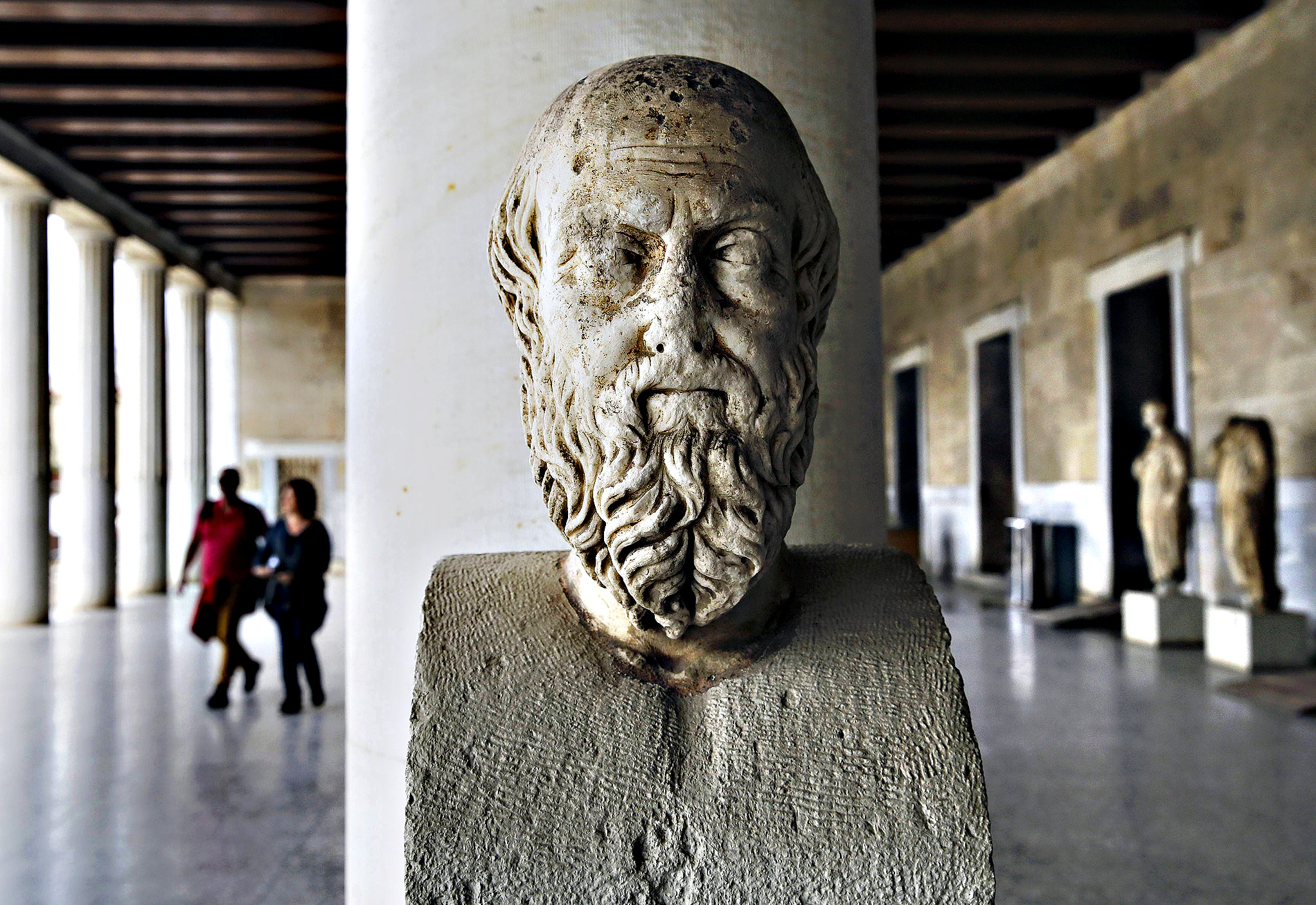
Herodotus (484 BC – c. 425 BC) was a Greek Historian as well
as known as the Father of Lies. These
two titles were commonly held hand in hand as the early recorders of history
were attempting to record an objective recounting of events while taking their
stories from first-hand, second-hand, third-hand, etc accounts instead of
recording a direct experience. Also
entwined in the pejorative label of “Father of Lies” is that Herodotus was susceptible
to subjective inclusion or exclusion of histories based on his personal
involvement with peoples. Thebans and
Corinthians who both denied him funds for his work subsequently suffered not the prettiest of
pictures when recounted in Herodotus' work.
Athenians gave him a fortune, thus perhaps securing a favorable telling
of their exploits. Regardless, Herodotus
was one of the first writers to bring together historical accounts (whether
tweaked by the tellers or himself or not) and the only one to have survived in
the form of The Histories. Therefore,
the moniker of Father of History sticks.
What is known about Herodotus's life is suspect, not unlike
any ancient figure subject to the development of accurately written
records. What is most often referred to
is an eleventh-century Byzantine lexicon, the Suda. According to this document, Herodotus was
born in Halicarnassus and that at some point was banished from his birthplace
by the tyrant Lygdamis to the island of Samos.
He returned to Halicarnassus to participate in the overthrowing of the
tyrant but was not in the favor of the citizens and therefore left for Thurii,
a colony in Southern Italy that was Athenian-led. This is where he perhaps died although there
is speculation that he may have perished in Macedonia at Pella. He wrote in the Ionian dialect of Greek which
differed from the Dorian community of Halicarnassus although the public
documents were written in Ionian. It is
also possible that Herodotus picked up the usage of Ionian while on Samos; due
to the repeated aggressions of his birthplace upon himself (first the tyrant,
then citizens) this may have inspired Herodotus to discard the Dorian
dialect. The tradition of exiling
historians did not stop with Herodotus, and in truth it may that it is merely
assumed that he was exiled twice, it was rather common for following historians
to be exiled from their homelands as well.
And for Herodotus, this does seem to ring true for it can be seen as the
condition to inspire his wide travels.
Another aspect that may play a role in allowing Herodotus to
find the wherewithal to travel and experience widely with an open mind towards
peoples and places outside of Greece was the friendliness of the city
Halicarnassus to the Carians, subject to Persia. The city also helped to develop Greek trade
with Egypt and maintained an international feel. Herodotus himself is said to have traveled to
the islands of the Archipelago, the Persian capital Susa, Babylon, Colchis,
Scythia, Thrace; he saw the shores of not only the Black Sea as far as Dnieper,
but those of Palestine as well, seeing Gaza.
This is a mere slice of the destinations that Herodotus undertook in his
search for 'human achievements' and 'to say what it said'. History did not necessarily begin as an
attempt to frame events objectively as it came to be known. The original Greek, historia was used to
describe investigation and inquiry and by traveling, seeing what he could see
and hearing what he could hear, Herodotus set out to inquire upon human
achievements. The point that Herodotus
was out to recount specifically 'human' achievement' set him apart from epic
poets who tell tales of gods and humans.
Upon visiting a place that he was out to understand, Herodotus would
take in everything he could see from monuments to customs to architecture to
climate. Herodotus would also talk to
many people and would recount the different accounts before choosing to promote
the one that he found most probable.
This is probably what garnered him the moniker of Father of Lies for
within his history exist some pretty tall tales.
What Herodotus did with what he had learned is very
well-known as The Histories, but this chunk of prose published all at once was
not what he would have been known for until later in his life. It is speculated that The Histories must have
been around 415 BC. Before that,
Herodotus's craft would have looked very much like Homer's. The culture around the Mediterranean was oral
and not written and just as Herodotus gained his knowledge from oral
storytelling, he passed on much of it in this way as well. Herodotus would travel not only to gather
information and histories, but to expel some of his gained wisdom and tales at
larger festivals that would gather large diverse crowds, or within smaller
gatherings not unlike the description of such a get together in Plato's
Symposium. When reading The Histories it
is possible to see how the different books may be broken down into smaller
chunks that were individual performance pieces.
When The Histories were collected, they were broken into
nine parts, each named after the nine Muses with Clio, the Muse of History
taking claim over the first book. The
rest of the book follows what can be seen as a loose history of four Persian
kings. The history of Cyrus takes up the
first book, Cambyses takes up Book 2 and some of three which leads into the
dynastic history of Darius whose reign fills up the books up to 6, and finally
Xerxes caps of The Histories in Books 7 and 8.
This is perhaps the most broad way to get an overview of the crafting of
The Histories although Herodotus learned, perhaps from Homer, that this method
is excellent for storing great variety and movement of many narratives. The Persian-Greek Wars provided some
time-line thematic structure (even though Herodotus would weave backwards and
forwards in time at point), but other thematic structure is to be found as well
throughout The Histories. One such theme
was Herodotus's view of the interaction of human action and its influence on historical
causation, that of retribution and vengeance and that those who wrong others
will see their payment coming to them.
Another such theme is Herodotus's commonly held Greek belief that pride
goes before the inevitable fall. This
hubris is often seen in Herodotus's histories as the expansion of empires.
Herodotus was incredibly popular in his time and following,
but along with this popularity came great derision on the part of some critics,
mostly due to the inconsistency of his stories with the truth. But even those fantastical tales, like the
one about Pakistan with its fox-sized furry ants that dig gold up from the
ground have been found to be true as more and more we still come to understand
the world. (The ants are actually
marmots who burrow in gold dust rich sand, as found by French ethnologist,
Michel Peissel.) More important than the
truth of Herodotus's stories, however, is what they accomplished. By telling stories of many different peoples
in light of Greek culture, he was able to build a sense of place in and amongst
the world for not only a Greek audience but others who could see the human
achievements available anywhere with human failings being as easily found as
well. As John Marincola remarks in his
introduction to The Histories in connection to the terrible criticism of this
Father of History:
If, however, we eliminate these preconceptions and
expectations, we may be better able to see Herodotus as a complex writer, who
viewed the past not exclusively through the narrow prism of wars and politics,
but in the variety and richness of what human beings had sought to achieve
[…] For he did nothing less than attempt
to fashion for his contemporaries (and in a different way, for those who still
read him) a portrait of themselves and of others, and of the vast world, both
physical and metaphysical, within which their actions take place.”