Monday, February 29, 2016

Cicero


1. Read “Cicero” (Sections 1-6)                                                         2. Read “Cicero’s Rhetoric”
3. Optional Reading” “Oration for Sextus Roscius of Ameria”

Monday, February 15, 2016

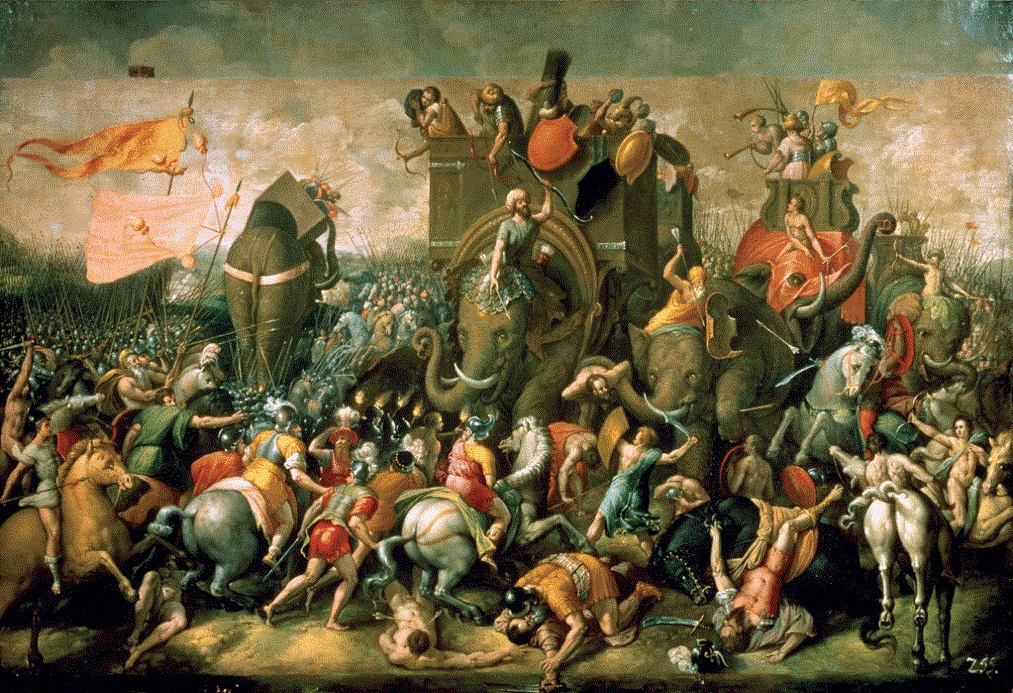
The Rise and Fall of Hannibal


The Rise and Fall of Hannibal (Content note, some scenes of violence)

Ciceronian Speech Information


Principal Rhetorical and Literary Devices 

1. Alliteration: repetition of the same letter at beginning of words or syllables: Marcus me momordit.

2. Anaphora: the repetition of a word or phrase for emphasis: non feram, non sinam, non patiar

3. Anastrophe: inversion of usual word order (e.g., preposition after the word it governs): te propter vivo (instead of the expected propter te vivo)

4. Aposiopesis: breaking off in the middle of a sentence : quem ego . . . sed non possum pergere. ("Whom I . . . but I cannot go on.")

5. Apostrophe: addressing a person who is not present: O maiores, quid diceretis de hac re? ("Oh ancestors, what would you say about this matter?")

6. Asyndeton: omission of conjunctions: videt, sentit, scit.

7. Chiasmus: "a-b-b-a" arrangement of words: magnas urbes oppida parva (adjective, noun, noun, adjective)

8. Ellipsis: omission of words: Dixit me inventum. ("He said I had been found." esse is missing).

9. Hendiadys: use of two nouns together to express a noun modified by an adjective: luctus et labor (meaning "grievous toil")

10. Hyperbole: exaggeration. Catilina est mons vitiorum. ("Catiline is a mountain of vices.")

11. Hysteron proteron: placing first what the reader might expect to come last mortuus est et hostem inruit ("He died and he rushed against the enemy")

12. Litotes: use of a negative to express a strong positive Haud stultus erat Cicero. ("Cicero was very intelligent").

13. Metaphor: expression of meaning through an image Horatius est lux litterarum Latinarum. ("Horace is the light of Latin literature.")

14. Metonymy: substitution of one word for another that it suggests Neptunus me terret (to mean, "the sea frightens me").

15. Onomatopoeia: use of words that sound like their meaning Murmurant multi (the "m"’s produce the sound of murmuring).

16. Oxymoron: use of an apparent contradiction parvum monstrum

17. Personification: attribution of human characteristics to something not human Ipsa saxa dolent. ("The rocks themselves grieve")

18. Pleonasm: use of superfluous words Oculis me videt. ("She sees me with her eyes.")

19. Polysyndeton: use of many conjunctions et videt et sentit et scit

20. Prolepsis (anticipation): use of a word sooner than it would logically appear submersis obruit puppis ("he overwhelms the sunken ships").

21. Simile: comparison using a word like sicut, similis, or velut. Volat sicut avis. ("He flies like a bird.")

22. Synecdoche: use of part to express a whole Prora in portam navigavit. ("The ship sailed into the harbor." prora [prow] for navis [ship]).

23. Tmesis: the separation of a compound word into two parts saxo cere comminuit brum (for saxo cerebrum comminuit: "He smashed his brain with a rock.").

24. Tricolon crescens (ascending tricolon): combination of three elements, increasing in size non ferar, non patiar, non tolerabo

25. Zeugma: use of one word in two different senses simultaneously Aeneas tulit dolorem et patrem Troia. (Aeneas carried grief and his father from Troy)

Monday, February 8, 2016

The 12 Tables


The earliest attempt by the Romans to create a code of law was the Laws of the Twelve Tables. A commission of ten men (Decemviri) was appointed (c. 455 B.C.) to draw up a code of law binding on both patrician and plebeian and which consuls would have to enforce. The commission produced enough statutes  to fill ten bronze tablets. The plebeians were dissatisfied  and so a second commission of ten was therefore appointed (450 B.C.) and two additional tablets were added. 

What follows are a selection from the Twelve Tables. [Source: Oliver J. Thatcher, ed., The Library of Original Sources (Milwaukee: University Research Extension Co., 1901), Vol. III: The Roman World, pp. 9-11. See also Lex Duodecim Tabularum, by George Long in William Smith, A Dictionary of Greek and Roman Antiquities, John Murray, London, 1875, pp. 688-690.]

*          *          *
Table I.
1. 
If anyone summons a man before the magistrate, he must go. If the man summoned does not go, let the one summoning him call the bystanders to witness and then take him by force.
2. 
If he shirks or runs away, let the summoner lay hands on him.
6-9.
 When the litigants settle their case by compromise, let the magistrate announce it. If they do not compromise, let them state each his own side of the case, in the comitium of the forum before noon. Afterwards let them talk it out together, while both are present. After noon, in case either party has failed to appear, let the magistrate pronounce judgment in favor of the one who is present. If both are present the trial may last until sunset but no later.

Table II.
2.
 He whose witness has failed to appear may summon him by loud calls before his house every third day.

Table III.
1.
 One who has confessed a debt, or against whom judgment has been pronounced, shall have thirty days to pay it in. After that forcible seizure of his person is allowed. The creditor shall bring him before the magistrate. Unless he pays the amount of the judgment or some one in the presence of the magistrate interferes in his behalf as protector the creditor so shall take him home and fasten him in stocks or fetters. He shall fasten him with not less than fifteen pounds of weight or, if he choose, with more. If the prisoner choose, he may furnish his own food. If he does not, the creditor must give him a pound of meal daily; if he choose he may give him more.
3.
 Against a foreigner the right in property shall be valid forever.

Table IV.
1. 
A dreadfully deformed child shall be quickly killed.
2.
 If a father sell his son three times, the son shall be free from his father.
5. 
A child born after ten months since the father's death will not be admitted into a legal inheritance.

Table V.
1.
 Females should remain in guardianship even when they have attained their majority.

Table VI.
1.
 When one makes a bond and a conveyance of property, as he has made formal declaration so let it be binding.

Table VII.
1.
 Let them keep the road in order. If they have not paved it, a man may drive his team where he likes.
9. Should a tree on a neighbor's farm be bent crooked by the wind and lean over your farm, you may take legal action for removal of that tree.
10. A man might gather up fruit that was falling down onto another man's farm.

Table VIII.
2. If one has maimed a limb and does not compromise with the injured person, let there be retaliation. If one has broken a bone of a freeman with his hand or with a cudgel, let him pay a penalty of three hundred coins. If he has broken the bone of a slave, let him have one hundred and fifty coins. If one is guilty of insult, the penalty shall be twenty-five coins.
3. If one is slain while committing theft by night, he is rightly slain.
4. If a patron shall have devised any deceit against his client, let him be accursed.
10. Any person who destroys by burning any building or heap of corn deposited alongside a house shall be bound, scourged, and put to death by burning at the stake provided that he has committed the said misdeed with malice aforethought; but if he shall have committed it by accident, that is, by negligence, it is ordained that he repair the damage or, if he be too poor to be competent for such punishment, he shall receive a lighter punishment.
23. A person who had been found guilty of giving false witness shall be hurled down from the Tarpeian Rock.
26. No person shall hold meetings by night in the city.

Table IX.
4. The penalty shall be capital for a judge or arbiter legally appointed who has been found guilty of receiving a bribe for giving a decision.
5. Treason: he who shall have roused up a public enemy or handed over a citizen to a public enemy must suffer capital punishment.
6. Putting to death of any man, whosoever he might be unconvicted is forbidden.

Table X.
1. None is to bury or burn a corpse in the city.
3. The women shall not tear their faces nor wail on account of the funeral.

Table XI.
1.
 Marriages should not take place between plebeians and patricians.


Table XII.
5.
 Whatever the people had last ordained should be held as binding by law.

Roman Documentary (Optional)

If you enjoyed researching Roman tombstones, you might want to check out this series.

Meet the Romans 1


Friday, February 5, 2016

Roman Comedy Guidelines


  • Minimum Length: 7 minutes, (Max 20 minutes). 
  • Should correctly represent the characters as listed in the syllabus
  • Should include, at least, the Young Man, the Wise Servant, the Young Woman, and at least 3 of the other characters.
  • Should include props, where listed in the syllabus and togas (you may use sheets). 
  • Should include a prologue.
  • Should include at least 2 distinct, but related episodes.
  • Should include the required plot devices (Anagnorisis and Peripeteia)

Monday, February 1, 2016

Roman Comedy Draft Guidelines

This week, after reading the Roman Comedy information in the syllabus, please watch the Importance of Being Earnest (you may watch a different version, if you prefer) as well as at least one Jeeves and Wooster episode. Using these sources and the information from the syllabus, please write a complete plot for your story. Your plot sketch should be double-spaced to allow for notes in class as you work together on improving your comedies. Please ask any questions in the comments below.

Example of a Roman Comedy Plot (more or less...)

Roman Tombstone Guidelines


Roman Tombstones Project Guidelines:

1. Create a tombstone based upon the examples.

It may be a simple drawing, however extra credit will be offered for a three dimensional stone. (25 points for a three dimensional tombstone, 50 for a three dimensional stone with a sculptural element, and 100 points for a stone that accurately recreates a Roman  tombstone [such as the tombstone in the image above] in both size [more than 10 inches high], artistry, and form).

If you elect to use a Latin inscription from the examples, you will have to add data on the person buried in the tomb using the guidelines for how Romans recorded information about the deceased on their tombstones.This should either use information from the Latin inscription to determine the name/occupation/etc. of the deceased or add imagined information if none is present in the inscription. 

2. Write a short story (1 page) about the deceased individual(s). Using the information from the tombstone, (either the quotation or information about the individual) and historical data gleaned from "As the Romans" imagine some aspect of their life and its conclusion. This will be shared in class.  


Epitaphs for Women 

Epitaphs for Men

Epitaphs for Children

Understanding Epitaphs


Explaining Roman Epitaphs

How a tombstone's text was written...


Start 
D M = Dis Manibus = to the spirit of

Who 
F = Filius son of or Filia = Daughter of
PATER = father (of) (Mater = mother of)
PATRONUS = patron
DOMINUS master (or Domma for women)
LIBERTUSII = freedman/men (LIBERTA = Freedwoman)
CONIUX PIENTISSIMA = and very loyal wife CONIUNX = wife

Age 
VIX AN XIV = vixit annos XIV = he/she lived for 14 years. Numbers: I=1 IX=9 II=2 X=10 III=3 XIV=14 IV=4 L=50 V=5 XL=40 VI=6 C=100

Occupation
CENTURIO = centurion
MIL = MILES = soldier
OPT = OPTIO = lieutenant
SIGNIFER = standard-bearer
TRIB = Tribunus = tribune
VET = Veteranus veteran, retired soldier
P PILUS = Primus Pilus = First Spear — the head centurion in a legion
SACERDOS DEAE SULIS = priest of the goddess Sulis V C = Vir Clarissimus = Senator ORNATRIX = Hairdresser
VESTALI = Vestal (a type of priestess)
LEG (Legio) = Legion — usually followed by the number and sometimes a legions name e.g. Legio Vl AGRICOLA = Farmer
MEDICUS / MEDICA = Doctor or Physician
TEXTRIX = Weaver
ALUMNO = Student

Who had the stone made? 
H F C = heres faciendum curavit = The heir had [the tombstone] made.
F C = .... Faciendum curavit = [name] had this made.
F MON = .... Fecit Monumentum = [Name] erected/made this monument You could add EXS TEST = ex testamento = in accordance with his Will.

Extra Endings (optional)
 H S E = hic situs est = Here he lies.
T TIB TERRA LEVIS = Sit Tibi Terra Levis may the earth lie lightly upon you
HOC M VETO VENIRI VETO DONARI Hoc Monumentum Veto venire veto donari = I forbid that this monument be sold; I forbid it be given away.

Here’s an example:

DMGIUS JULIUS F MARCUS VIX AN XXIV EQUES LEG V GERMANIA MARCUS ANTONIUS F C

This means: “To the spirit of Gius Julius son of Marcus. He lived for 24 years, cavalryman in the 5th Legion ‘Germania.’ Marcus Antonius had this made.”

*********************************************************************************


DO YOU HAVE SOMETHING TO POST?

If you have an item that you think we should post on this blog, write it up and click here to send it to us. New entries are reviewed at least once a week.