Plutarch's Pompey Reading
Young Folk's Plutarch Pompey Audiobook
Tuesday, February 14, 2017

Tuesday, February 7, 2017
Thursday, February 2, 2017
Saturday, January 21, 2017
Tuesday, January 3, 2017
Tuesday, November 29, 2016
Plutarch's Alcibiades
Link to the Plutarch reading on Alcibiades
Audiobook verion of the Alcibiades reading:
Alcibiades Part 1
Alcibiades Part 2
Alcibiades Part 3
Alcibiades Part 4
Plutarch's Alcibiades, short version:
THE MAN WITH MANY FACES
TWO boys were wrestling in the streets of Athens, each trying to fling the other to the ground. One of them was just on the point of [52] falling when he bit the hands of his rival, and made him let go his hold.
"Ho!" cried the other wrestler, "you are biting like a woman!"
"No," he replied, "I bite like a lion."
Well, lions may bite if they please; but it does not appear to me to be manly for lads to bite, even in sport.
The boy who bit had a long Greek name—Alcibiades (Al-ki-by-a-deez). He lived from about 450 B.C. to 404 B.C.
One day he was playing at dice with other Athenian lads in the street. Just as he was about to throw the little square blocks of bone a wagon rumbled along, and Alcibiades called out to the driver to stop. The man took no notice of the boy's call, and came on. Thereupon Alcibiades laid himself across the narrow road, and dared the driver to run over him. This, of course, the driver would not do, and he was obliged to come to a halt, and the boy laughed at having got his own way.
When he grew to be a young man he was the talk of the city. He was rich, his house was splendid, his clothes costly; and many persons followed him and courted him in the hope of getting favors and gifts. As a man, he did strange freaks just the same as in his earlier years, and the Athenian folk would tell each other, with smiles, stories of [53] his jests and peculiar deeds. He would not play the flute because he said it made the player twist his mouth into ugly shapes, but he would rather play the stringed instrument called the lyre. And the young men of Athens followed his fashion, and none of them would buy or touch a flute.
A certain man invited Alcibiades to a feast at his house, and prepared a grand meal, setting gold and silver vessels on his table. Many guests were entering the banqueting-hall, when Alcibiades suddenly strode in, attended by several of his serving-men, and he bade them snatch up half the precious cups and carry them away. And they did so. The guests expected the master of the house to rush after Alcibiades and angrily demand his cups back again. The foolish man, however, only said:
"No, let him go. After all, he has only taken half, and if he had liked he might have taken all."
The fact was he was so stupidly fond of Alcibiades that he was ready to give him his richest ornaments. And all the time Alcibiades did not feel respect for these people who were so eager to make his acquaintance. He seemed (at any rate, sometimes) to care much for the company of Socrates. Now, Socrates was an ugly-looking man, who would sit in the market-place of Athens, or in the house of a friend, and talk to the people [54] who gathered about his chair. He was the best and wisest of the citizens, and young men would listen to his speech with great eagerness. I fear, however, that Alcibiades loved many other things quite as much as he loved Socrates, and these things were not always good or useful. He seemed to be a man with many faces. One day he would wear the face of a student, fond of learning. The next day he would wear the face of a clown, taking delight in jokes. He was very changeable.
Having met a well-known and honorable man, Alcibiades went up to him and gave him a box on the ears for no reason whatever, except that he had told his companions he would do so, and they would not believe it. The next morning he called at the house of the old citizen whom he had thus insulted and begged his pardon, and even offered to take any beating which the gentleman might care to give him. But the Athenian bore no ill-will, and freely forgave the daring young man; and I suppose the people passed the story round as a merry jest. He knew the citizens talked about him. He would have been rather miserable if they had not, for he was of a vain and conceited temper. Having bought a very fine dog for a considerable sum of money, he actually cut off the creature's beautiful bushy tail.
"Everybody in the town is talking about the [55] odd way in which you treated your dog," a friend told him.
"This," he replied, "is just what I wanted, for I would rather have the Athenians talk of this action, lest they might find something worse to say about me!"
You will be amused to hear that he, like many Athenians, was fond of breeding a sort of bird called quails. If you look in your book of natural history and examine a picture of a quail, you may not think it a very handsome bird; but it was the fancy of the young men in Athens to make pets of these quails, and Alcibiades used often to carry one under his robe. When he walked in the streets once his quail got loose, and a whole crowd of people went scampering after it to see which should have the honor of restoring it to the owner! They thought Alcibiades a very jolly fellow, and especially when he once sent seven chariots to the Olympic games to take part in the races. Loud were the shouts as he dashed by in one race after another, raising an immense dust about the hoofs of the horses and the wheels of his chariots. He won three prizes, and was so pleased at the result that at his own expense he gave a feast to all the thousands of people who had witnessed the races. When he passed along public places, dressed in a long purple cloak, he was gazed at with much admiration.
[56] "Here is a noble leader for us," some people would say. "See how handsome a man he is; how well he would lead us in war!"
You may remember how I told you of the long, long war (it lasted twenty-eight years) between Athens and Sparta. This struggle was now going on, and the man in the purple cloak—the man with many faces—thought he could be a mighty warrior as well as a flute-player, a quail-breeder, a chariot-racer, and a friend of Socrates. He would make speeches to the crowds, and tell them what a great city Athens was, and what victories she would win. One shrewd man, named Timon, called out to him once:
"Go on, my brave boy, and prosper; for your prosperity will bring ruin on all this crowd."
He meant that, if the people put their faith in Alcibiades, it would do no good to the city.
But for a while Alcibiades made himself a famous name in the wars, and won several battles; and when the Athenians (as I have related) set sail to conquer Sicily he was captain of one hundred and forty galleys, fifty-one hundred soldiers in heavy armor, and thirteen hundred archers and slingers. But he did nothing of much note in Sicily, and was called back to Athens to answer a charge. It was brought against him that, one night, in a mad trick, he and his friends had [57] gone round the streets breaking the images of Hermes (Her-mees), which stood at the doors of all houses in Athens. These images were guardians of the homes, and it was thought a very dreadful thing to interfere with them. Whether Alcibiades had really done this I do not know, but people knew his character, and thought he was quite likely to have insulted the images; and he was condemned to lose his property, and to be sent into exile. Where do you think he went to? He went to Sparta, the city which hated Athens, and was making war against his own native place. In Sparta he acted as he did in Athens. He tried to set everybody admiring him. All his fine clothes were hidden away; he was now dressed in coarse garments; his curls were clipped, his hair close-shaven; he ate the Spartan black bread, and drank the black broth, and sat on rough wooden seats, and would have neither carpets nor pictures in his house. This pleased the people of Sparta, and that was all Alcibiades cared for. He pleased them yet more when he joined their armies, and took part in the war against his own countrymen. When, at length, the King of Sparta grew suspicious of him, and thought he was not to be trusted, the man with many faces went over to Asia Minor, and took refuge with a Persian grandee, or nobleman; and the Persians, as you have heard, were bitter foes to the Athenians, [58] but it was all the same to Alcibiades. With the Persians he drank and ate, and sang and hunted; and they also regarded him as a fine fellow. Later on he changed again, and took the side of Athens, and helped in a sea-battle against the Spartans, and won a victory. Other battles were won, and the citizens welcomed him back, gave him his lands again, and crowned him with crowns of gold.
But this glory did not last. The Spartans were masters at the end of the war, and the walls of Athens lay in ruin.
And where was Alcibiades? He had fled to Asia again, and there the Persians slew him, in order to please the powerful Spartans. They had set fire to his house one night. He sallied out, sword in hand, and died fighting.
Certainly, he was clever; and he was witty; and he was handsome; and he was brave; and he was popular—that is, people thought a great deal of him. And do you consider he was good? No. And why not? His aim was always to make the folk admire him, wonder at him, and talk about him. From one thing to another he changed; in one respect only he was forever the same—he never seemed to care for any one but himself. Socrates was ugly; but we honor his memory. Alcibiades was handsome; his cloak was rich purple; his house filled with treasures; [59] but we do not honor his memory. He could not teach even a dog to love him; neither could any man trust him.
Audiobook verion of the Alcibiades reading:
Alcibiades Part 1
Alcibiades Part 2
Alcibiades Part 3
Alcibiades Part 4
Plutarch's Alcibiades, short version:
THE MAN WITH MANY FACES
TWO boys were wrestling in the streets of Athens, each trying to fling the other to the ground. One of them was just on the point of [52] falling when he bit the hands of his rival, and made him let go his hold.
"Ho!" cried the other wrestler, "you are biting like a woman!"
"No," he replied, "I bite like a lion."
Well, lions may bite if they please; but it does not appear to me to be manly for lads to bite, even in sport.
The boy who bit had a long Greek name—Alcibiades (Al-ki-by-a-deez). He lived from about 450 B.C. to 404 B.C.
One day he was playing at dice with other Athenian lads in the street. Just as he was about to throw the little square blocks of bone a wagon rumbled along, and Alcibiades called out to the driver to stop. The man took no notice of the boy's call, and came on. Thereupon Alcibiades laid himself across the narrow road, and dared the driver to run over him. This, of course, the driver would not do, and he was obliged to come to a halt, and the boy laughed at having got his own way.
When he grew to be a young man he was the talk of the city. He was rich, his house was splendid, his clothes costly; and many persons followed him and courted him in the hope of getting favors and gifts. As a man, he did strange freaks just the same as in his earlier years, and the Athenian folk would tell each other, with smiles, stories of [53] his jests and peculiar deeds. He would not play the flute because he said it made the player twist his mouth into ugly shapes, but he would rather play the stringed instrument called the lyre. And the young men of Athens followed his fashion, and none of them would buy or touch a flute.
A certain man invited Alcibiades to a feast at his house, and prepared a grand meal, setting gold and silver vessels on his table. Many guests were entering the banqueting-hall, when Alcibiades suddenly strode in, attended by several of his serving-men, and he bade them snatch up half the precious cups and carry them away. And they did so. The guests expected the master of the house to rush after Alcibiades and angrily demand his cups back again. The foolish man, however, only said:
"No, let him go. After all, he has only taken half, and if he had liked he might have taken all."
The fact was he was so stupidly fond of Alcibiades that he was ready to give him his richest ornaments. And all the time Alcibiades did not feel respect for these people who were so eager to make his acquaintance. He seemed (at any rate, sometimes) to care much for the company of Socrates. Now, Socrates was an ugly-looking man, who would sit in the market-place of Athens, or in the house of a friend, and talk to the people [54] who gathered about his chair. He was the best and wisest of the citizens, and young men would listen to his speech with great eagerness. I fear, however, that Alcibiades loved many other things quite as much as he loved Socrates, and these things were not always good or useful. He seemed to be a man with many faces. One day he would wear the face of a student, fond of learning. The next day he would wear the face of a clown, taking delight in jokes. He was very changeable.
Having met a well-known and honorable man, Alcibiades went up to him and gave him a box on the ears for no reason whatever, except that he had told his companions he would do so, and they would not believe it. The next morning he called at the house of the old citizen whom he had thus insulted and begged his pardon, and even offered to take any beating which the gentleman might care to give him. But the Athenian bore no ill-will, and freely forgave the daring young man; and I suppose the people passed the story round as a merry jest. He knew the citizens talked about him. He would have been rather miserable if they had not, for he was of a vain and conceited temper. Having bought a very fine dog for a considerable sum of money, he actually cut off the creature's beautiful bushy tail.
"Everybody in the town is talking about the [55] odd way in which you treated your dog," a friend told him.
"This," he replied, "is just what I wanted, for I would rather have the Athenians talk of this action, lest they might find something worse to say about me!"
You will be amused to hear that he, like many Athenians, was fond of breeding a sort of bird called quails. If you look in your book of natural history and examine a picture of a quail, you may not think it a very handsome bird; but it was the fancy of the young men in Athens to make pets of these quails, and Alcibiades used often to carry one under his robe. When he walked in the streets once his quail got loose, and a whole crowd of people went scampering after it to see which should have the honor of restoring it to the owner! They thought Alcibiades a very jolly fellow, and especially when he once sent seven chariots to the Olympic games to take part in the races. Loud were the shouts as he dashed by in one race after another, raising an immense dust about the hoofs of the horses and the wheels of his chariots. He won three prizes, and was so pleased at the result that at his own expense he gave a feast to all the thousands of people who had witnessed the races. When he passed along public places, dressed in a long purple cloak, he was gazed at with much admiration.
[56] "Here is a noble leader for us," some people would say. "See how handsome a man he is; how well he would lead us in war!"
You may remember how I told you of the long, long war (it lasted twenty-eight years) between Athens and Sparta. This struggle was now going on, and the man in the purple cloak—the man with many faces—thought he could be a mighty warrior as well as a flute-player, a quail-breeder, a chariot-racer, and a friend of Socrates. He would make speeches to the crowds, and tell them what a great city Athens was, and what victories she would win. One shrewd man, named Timon, called out to him once:
"Go on, my brave boy, and prosper; for your prosperity will bring ruin on all this crowd."
He meant that, if the people put their faith in Alcibiades, it would do no good to the city.
But for a while Alcibiades made himself a famous name in the wars, and won several battles; and when the Athenians (as I have related) set sail to conquer Sicily he was captain of one hundred and forty galleys, fifty-one hundred soldiers in heavy armor, and thirteen hundred archers and slingers. But he did nothing of much note in Sicily, and was called back to Athens to answer a charge. It was brought against him that, one night, in a mad trick, he and his friends had [57] gone round the streets breaking the images of Hermes (Her-mees), which stood at the doors of all houses in Athens. These images were guardians of the homes, and it was thought a very dreadful thing to interfere with them. Whether Alcibiades had really done this I do not know, but people knew his character, and thought he was quite likely to have insulted the images; and he was condemned to lose his property, and to be sent into exile. Where do you think he went to? He went to Sparta, the city which hated Athens, and was making war against his own native place. In Sparta he acted as he did in Athens. He tried to set everybody admiring him. All his fine clothes were hidden away; he was now dressed in coarse garments; his curls were clipped, his hair close-shaven; he ate the Spartan black bread, and drank the black broth, and sat on rough wooden seats, and would have neither carpets nor pictures in his house. This pleased the people of Sparta, and that was all Alcibiades cared for. He pleased them yet more when he joined their armies, and took part in the war against his own countrymen. When, at length, the King of Sparta grew suspicious of him, and thought he was not to be trusted, the man with many faces went over to Asia Minor, and took refuge with a Persian grandee, or nobleman; and the Persians, as you have heard, were bitter foes to the Athenians, [58] but it was all the same to Alcibiades. With the Persians he drank and ate, and sang and hunted; and they also regarded him as a fine fellow. Later on he changed again, and took the side of Athens, and helped in a sea-battle against the Spartans, and won a victory. Other battles were won, and the citizens welcomed him back, gave him his lands again, and crowned him with crowns of gold.
But this glory did not last. The Spartans were masters at the end of the war, and the walls of Athens lay in ruin.
And where was Alcibiades? He had fled to Asia again, and there the Persians slew him, in order to please the powerful Spartans. They had set fire to his house one night. He sallied out, sword in hand, and died fighting.
Certainly, he was clever; and he was witty; and he was handsome; and he was brave; and he was popular—that is, people thought a great deal of him. And do you consider he was good? No. And why not? His aim was always to make the folk admire him, wonder at him, and talk about him. From one thing to another he changed; in one respect only he was forever the same—he never seemed to care for any one but himself. Socrates was ugly; but we honor his memory. Alcibiades was handsome; his cloak was rich purple; his house filled with treasures; [59] but we do not honor his memory. He could not teach even a dog to love him; neither could any man trust him.
Thursday, November 10, 2016
Plutarch's Pericles
Link to the Plutarch Reading on Pericles
Audiobook version of the Pericles readings:
Pericles 1
Pericles 2
Pericles 3
Pericles 4
Plutarch's Pericles (Short Version)
THE MAN WHO MADE ATHENS BEAUTIFUL
"YOUR head is like an onion!"
No answer.
"You brute, you scamp, your head is too big for your body."
No answer.
The man who did not answer was Pericles (Per-i-kleez), ruler of the State of Athens. Why the fellow was shouting at him along the street in this way I do not know. Pericles quietly kept on his road till he reached the door of his house. It was getting dusk, but through the darkness the [39] voice behind still bawled. Pericles called to one of his servants:
"Bring a lighted torch," he said, "and show this person the way home."
That was all the reply that Pericles gave to the rude Athenian. You see, he was a man of self-command. He did not break into a fury when he was insulted. This was not because he was weak or timid. When Athens was at war, Pericles joined the army, or sailed with the fleet.
He was a great favorite with the people; and you will not wonder at it when I tell you what he did for them. Any poor Athenian was allowed money to pay for admission to the open-air theatre. Soldiers were paid wages; and every year sixty galleys cruised about the sea for eight months, and the men who were trained in these ships as sailors were paid all the time. Corn was sold to poor persons very cheap. And parties of two hundred and fifty, and even one thousand, persons were sent across the water to settle in foreign cities where they would still be protected by the power of Athens. And if you had walked about the city in the days of Pericles, you would have seen large numbers of men at work building walls, archways, and temples, and using vast loads of stone, brass, ivory, gold, ebony-wood, cypress-wood, and so on. You would have seen carpenters, masons, braziers (or brass-workers), goldsmiths, painters, rope- [40] makers, leather-cutters, paviors (those who laid pavement down in the roads), wagoners, and porters. Handsome statues of gods and goddesses were set up in the temples and streets. One statue was that of the lady Athene (Ath-ee-nee), made of shining gold and polished white ivory; she wore a tunic that reached down to her feet; a spear was in her hand, a dragon lay on the ground before her, and two sharp-beaked griffins grew out of her helmet. Where did the money come from to pay for these things? Well, I am afraid it mostly came from taxes (or tribute), which the city of Athens forced out of other people in the lands and islands round about. So, though the galleys sailed proudly, and the statues looked splendid, and the people enjoyed the plays at the free theatres, the glory could not last, because it was got by spoil from other people. Pericles had the rule for forty years.
The heart of Pericles was generous, and he was ever ready to aid a man who was in want. An old philosopher (or teacher of wisdom) had become so poor that he wished to die, and he lay down in despair, and covered up his head. Some people ran to the ruler.
"Sir," they cried, "your old friend, the philosopher, has covered up his head!"
Pericles knew at once what that meant. In ancient Greece it was a sign that a man would [41] put an end to his life. The old philosopher meant to starve himself.
In great haste Pericles went to the house where his friend lay.
"My dear friend," he cried, "do not die like this. We cannot lose you; you are a man whom we love."
"Ah," groaned the old man, who was a wit in his way. "Ah, Pericles! those who want a lamp to burn always take care to keep it filled with oil."
He meant that if people cared for him they ought to keep him supplied with the food, etc., which he needed; and you may be sure that Pericles did not let his friend die.
Two years before his death a war broke out between Athens on the one side and Sparta and her allies (friends) on the other, and this war lasted thirty years; but Pericles only saw the beginning of it. Sad indeed he would have felt if he could have looked on to the close of the war and seen his beloved city defeated and its walls thrown down. He had fitted out a fleet of one hundred and fifty ships, and had just gone on board his own galley when the sky became dull and the earth took on a strange, gray color. Can you guess what had happened? The moon was passing between the sun and the earth, and so casting a shadow. It was an eclipse (or hiding) [42] of the sun. The Greeks were in much fear, and the pilot of the commander's ship trembled exceedingly. Then Pericles took off his cloak, and placed it over the man's eyes, and said:
"Are you frightened at my cloak eclipsing you?"
"No, sir."
"Well, then, why are you frightened at the eclipse of the sun, which happens to be caused by something bigger than my cloak?"
The pilot regained his nerve, and the story was told from mouth to mouth, and there was no more terror in the fleet.
However, the ships returned to Athens without having done anything very remarkable, and the citizens were angry, and made Pericles pay a heavy fine of money. Before long they changed their minds, restored him his money, and chose him again for leader of the State. But the days of Pericles were soon to end. At this time a dire plague began in the city, and many thousands of the folk died. Some say it was caused by so many people flocking into Athens to escape from the Spartan foe, and these strangers were mostly country persons who were used to the pure air of the fields, and who fell ill when they breathed the close air of the crowded houses of Athens. The sons of Pericles died, and one of these was specially beloved, and as the father laid a garland of flowers on the head of his dead son he burst into tears.
[43] And not long afterward he took the fever himself, and lay dying.
One day his friends were standing about his bed, and he was so still they thought him asleep or in a faint, and they spoke one to another of his life and deeds.
"How beautiful a city he has made Athens; and men from foreign lands come to admire it."
"The temple on the hill—how fine a piece of work is that; and we should never have had it if Pericles had not carried out the plan."
"And how the people took delight in going to the theatres free."
"The isles of the sea paid tribute to Athens because they feared the power of our ruler."
"Ah, my dear fellows," said Pericles, who had been listening, "other men have done such deeds as these. You have left out the one thing of which I am proud."
"What is that, sir?"
"It is the fact that no Athenian has ever put on mourning because of me, for I have caused the death of no dweller in this city."
And thus Pericles died.
Just a few words about the Maiden's Chamber before I finish. This was the temple on the hill that was mentioned by one of the friends of the dying ruler. In the Greek tongue the Maiden's Chamber was called the Parthenon (Parth-e-non).
[44] It was built of marble, and was about twice as long as it was broad. Instead of walls all round it there were tall pillars, eight at each end and fifteen at each side, so that whichever way you entered you would pass in between marble pillars. Inside the first rows of pillars was a second row, all the way round. And over the tops of the pillars, and all round the temple, were pictures in stone—I mean carvings. These carvings showed the battles of the gods and the wicked giants; the battle of the Athenian warriors with the fierce women of the North, called Amazons; and a procession of men on horses. If ever you would like to see any of these sculptured horses and men and women soldiers, you need not go to Greece. You can find plaster casts of them in the art museums of New York, Chicago, and other cities, though I am sorry to say they show that the originals, now in the British Museum, are very much battered and broken.
When the power of the Greeks had passed the temple was used as a church, and was named after the Virgin Mary. This was in what we called the Middle Ages (from about the year 400 to 1300 or 1400). Afterward the Turks were its masters, and made it into a mosque (mosk). In the year 1587 a war took place between the Turks and the people of Venice. And one day—what was that?
[45] Boom!
A store of gunpowder which had been placed in the temple by the Turkish soldiers had exploded, and the building was almost destroyed.
War is a hateful thing. It brings to ruin the lovely carvings of the Maiden's Chamber, and it slays men who were once pretty babes nestling at the breasts of their mothers.
Audiobook version of the Pericles readings:
Pericles 1
Pericles 2
Pericles 3
Pericles 4
Plutarch's Pericles (Short Version)
THE MAN WHO MADE ATHENS BEAUTIFUL
"YOUR head is like an onion!"
No answer.
"You brute, you scamp, your head is too big for your body."
No answer.
The man who did not answer was Pericles (Per-i-kleez), ruler of the State of Athens. Why the fellow was shouting at him along the street in this way I do not know. Pericles quietly kept on his road till he reached the door of his house. It was getting dusk, but through the darkness the [39] voice behind still bawled. Pericles called to one of his servants:
"Bring a lighted torch," he said, "and show this person the way home."
That was all the reply that Pericles gave to the rude Athenian. You see, he was a man of self-command. He did not break into a fury when he was insulted. This was not because he was weak or timid. When Athens was at war, Pericles joined the army, or sailed with the fleet.
He was a great favorite with the people; and you will not wonder at it when I tell you what he did for them. Any poor Athenian was allowed money to pay for admission to the open-air theatre. Soldiers were paid wages; and every year sixty galleys cruised about the sea for eight months, and the men who were trained in these ships as sailors were paid all the time. Corn was sold to poor persons very cheap. And parties of two hundred and fifty, and even one thousand, persons were sent across the water to settle in foreign cities where they would still be protected by the power of Athens. And if you had walked about the city in the days of Pericles, you would have seen large numbers of men at work building walls, archways, and temples, and using vast loads of stone, brass, ivory, gold, ebony-wood, cypress-wood, and so on. You would have seen carpenters, masons, braziers (or brass-workers), goldsmiths, painters, rope- [40] makers, leather-cutters, paviors (those who laid pavement down in the roads), wagoners, and porters. Handsome statues of gods and goddesses were set up in the temples and streets. One statue was that of the lady Athene (Ath-ee-nee), made of shining gold and polished white ivory; she wore a tunic that reached down to her feet; a spear was in her hand, a dragon lay on the ground before her, and two sharp-beaked griffins grew out of her helmet. Where did the money come from to pay for these things? Well, I am afraid it mostly came from taxes (or tribute), which the city of Athens forced out of other people in the lands and islands round about. So, though the galleys sailed proudly, and the statues looked splendid, and the people enjoyed the plays at the free theatres, the glory could not last, because it was got by spoil from other people. Pericles had the rule for forty years.
The heart of Pericles was generous, and he was ever ready to aid a man who was in want. An old philosopher (or teacher of wisdom) had become so poor that he wished to die, and he lay down in despair, and covered up his head. Some people ran to the ruler.
"Sir," they cried, "your old friend, the philosopher, has covered up his head!"
Pericles knew at once what that meant. In ancient Greece it was a sign that a man would [41] put an end to his life. The old philosopher meant to starve himself.
In great haste Pericles went to the house where his friend lay.
"My dear friend," he cried, "do not die like this. We cannot lose you; you are a man whom we love."
"Ah," groaned the old man, who was a wit in his way. "Ah, Pericles! those who want a lamp to burn always take care to keep it filled with oil."
He meant that if people cared for him they ought to keep him supplied with the food, etc., which he needed; and you may be sure that Pericles did not let his friend die.
Two years before his death a war broke out between Athens on the one side and Sparta and her allies (friends) on the other, and this war lasted thirty years; but Pericles only saw the beginning of it. Sad indeed he would have felt if he could have looked on to the close of the war and seen his beloved city defeated and its walls thrown down. He had fitted out a fleet of one hundred and fifty ships, and had just gone on board his own galley when the sky became dull and the earth took on a strange, gray color. Can you guess what had happened? The moon was passing between the sun and the earth, and so casting a shadow. It was an eclipse (or hiding) [42] of the sun. The Greeks were in much fear, and the pilot of the commander's ship trembled exceedingly. Then Pericles took off his cloak, and placed it over the man's eyes, and said:
"Are you frightened at my cloak eclipsing you?"
"No, sir."
"Well, then, why are you frightened at the eclipse of the sun, which happens to be caused by something bigger than my cloak?"
The pilot regained his nerve, and the story was told from mouth to mouth, and there was no more terror in the fleet.
However, the ships returned to Athens without having done anything very remarkable, and the citizens were angry, and made Pericles pay a heavy fine of money. Before long they changed their minds, restored him his money, and chose him again for leader of the State. But the days of Pericles were soon to end. At this time a dire plague began in the city, and many thousands of the folk died. Some say it was caused by so many people flocking into Athens to escape from the Spartan foe, and these strangers were mostly country persons who were used to the pure air of the fields, and who fell ill when they breathed the close air of the crowded houses of Athens. The sons of Pericles died, and one of these was specially beloved, and as the father laid a garland of flowers on the head of his dead son he burst into tears.
[43] And not long afterward he took the fever himself, and lay dying.
One day his friends were standing about his bed, and he was so still they thought him asleep or in a faint, and they spoke one to another of his life and deeds.
"How beautiful a city he has made Athens; and men from foreign lands come to admire it."
"The temple on the hill—how fine a piece of work is that; and we should never have had it if Pericles had not carried out the plan."
"And how the people took delight in going to the theatres free."
"The isles of the sea paid tribute to Athens because they feared the power of our ruler."
"Ah, my dear fellows," said Pericles, who had been listening, "other men have done such deeds as these. You have left out the one thing of which I am proud."
"What is that, sir?"
"It is the fact that no Athenian has ever put on mourning because of me, for I have caused the death of no dweller in this city."
And thus Pericles died.
Just a few words about the Maiden's Chamber before I finish. This was the temple on the hill that was mentioned by one of the friends of the dying ruler. In the Greek tongue the Maiden's Chamber was called the Parthenon (Parth-e-non).
[44] It was built of marble, and was about twice as long as it was broad. Instead of walls all round it there were tall pillars, eight at each end and fifteen at each side, so that whichever way you entered you would pass in between marble pillars. Inside the first rows of pillars was a second row, all the way round. And over the tops of the pillars, and all round the temple, were pictures in stone—I mean carvings. These carvings showed the battles of the gods and the wicked giants; the battle of the Athenian warriors with the fierce women of the North, called Amazons; and a procession of men on horses. If ever you would like to see any of these sculptured horses and men and women soldiers, you need not go to Greece. You can find plaster casts of them in the art museums of New York, Chicago, and other cities, though I am sorry to say they show that the originals, now in the British Museum, are very much battered and broken.
When the power of the Greeks had passed the temple was used as a church, and was named after the Virgin Mary. This was in what we called the Middle Ages (from about the year 400 to 1300 or 1400). Afterward the Turks were its masters, and made it into a mosque (mosk). In the year 1587 a war took place between the Turks and the people of Venice. And one day—what was that?
[45] Boom!
A store of gunpowder which had been placed in the temple by the Turkish soldiers had exploded, and the building was almost destroyed.
War is a hateful thing. It brings to ruin the lovely carvings of the Maiden's Chamber, and it slays men who were once pretty babes nestling at the breasts of their mothers.
Friday, October 28, 2016
Plutarch Links
Here is a link to the Solon reading:
Plutarch Reading on Solon
The link to all these readings can be found on the right side of the page in the research tools section.
Here is the Solon audiobook too, in case you are still struggling with navigating librivox.org
Solon 1
Solon 2
Solon 3
Also, here is a short version of the Plutarch reading to help you understand the story's outline.
Plutarch's Solon (Short Version)
A BUZZ of many voices was heard in the market-place of Athens. "Is he really mad?" asked one.
"Yes, you can see he is. Look at him now; he is leaping on to the herald's stone; and he wears a cap! Poor Solon; what a pity his brain should give way like this! Hark, he is beginning to speak."
The citizens of Athens crowded round the herald's stone, and listened to Solon. It was the custom for only sick people to wear caps, and Solon's strange appearance made the people readily believe the report that he was out of his mind. He recited a poem which he had composed beginning with the words:
Hear and attend!
From Salamis I came,
To show your error.
Solon was born about 638 B.C., and died about 558 B.C.
Salamis was an island whose mountains rose above the sea on the west of Athens. It was held by the Megarian people, who had taken it by force; and Solon so stirred up the spirit of Athens that the citizens made him commander of the men who should recapture the island. Solon played the following trick: He bade a number of young men dress in long, loose garments that made them appear like women; and he sent word to the Megarian warriors in Salamis that now they might have a good chance of seizing some of the principal ladies of Athens! The Megarians, not knowing the message was a trap laid by Solon, hurried into a ship, landed on the Athenian coast, and saw what seemed to be a crowd of women dancing at a festival. With a shout they rushed forward, but were much surprised when the supposed matrons drew swords and made a fierce defence. In the end all the Megarians were slain, and Solon afterward took possession of Salamis. You will meet many such tales of trickery in the history of war in ancient times; and I fear that in our own days also men do not hesitate to deceive their enemies, and they think it quite right to do so.
In another case of trickery the Athenian people were not so well pleased. The city had been troubled by quarrels between two parties who disagreed as to the best way of governing the State; and a number of men were beaten in the conflict and fled to the temple of the goddess Athene (Ath-ee-nee) for refuge. According to the custom of the time, no man might touch them while they remained under the care of the goddess. Some of the opposite party came to the gate, and said:
"Come out, like honest men, and go before the city magistrates, and let them judge if you are guilty or innocent."
"We dare not come out. You would slay us."
"No, not while you are under the protection of Athene; and we will give you a long thread, long enough to reach from here to the court of justice, and while you hold that we shall consider you as under the guardianship of the goddess."
So the men who had taken refuge in the temple tied the thread to the altar of Athene, and, while holding it, walked forth toward the place of the magistrates. But presently—perhaps by accident, perhaps by the act of some treacherous hand—the thread snapped. Then their foes fell upon them and killed them. But the people of Athens regarded this deed as a most wicked murder, and later on, when Solon was made chief ruler and lawgiver of the city, all the persons who took part in this action were sent into exile.
Many of the citizens wished Solon to take the crown. They thought he was a wise and just man, and would act as a wise and just king. Solon, however, had no mind for kingship; he was pleased to do his best to govern Athens, but had no wish for the glory of a crown or the splendor of a palace. He found the people of the Athenian country divided. There were, first, the Peasants of the Mountains, poor and hard-working, and always in debt to money-lenders; second, the Dwellers on the Coast, who were neither very rich nor very poor; and third, the Nobles of the Plain, who owned fruitful fields and orchards, and had much power. The poorest folk expected great help from Solon. They hoped he would wipe away all their debts, and they hoped he would take away the greater part of the land of the nobles and share it out among the people generally, as was done in Sparta. Solon did indeed wipe out their debts. He declared that all debts should be forgiven, so that the peasants might make a fresh start in life. Nor, even after that, would he allow any debtor to be seized and put into prison. For such had been the custom till then, every debtor being treated as if he were a wicked person. Solon heard of Athenians who had fled away into strange lands for fear of being cast into prison on account of money they owed, and he sent and brought them back; and all debtors who were in jail he set at liberty. You may be sure the poor and needy folk were filled with joy, and they now waited for him to divide the lands. But this Solon would not do, for he thought it would only upset the whole country; and, for that reason, some who had once praised him began to speak ill of him. Yet most of the citizens held him in great esteem, for they saw that in all he did he sought to do good to the people. Many laws he swept away. Before his days a lawgiver named Draco had ruled Athens so severely that he put to death men who only stole a few herbs from a garden; so that it was said that his laws were written not in ink, but in blood. I will set down a little list of some of Solon's laws:
He divided the people (leaving out the slaves) into four classes: The first class were men who had a yearly income of five hundred measures of corn; they must serve as horse-soldiers in the army, and they could vote at elections.
The second class were men who had a yearly income of three hundred measures of corn; they [13] also must serve as horse-soldiers in the army, and they could vote at elections.
The third class were men who had a yearly income of one hundred and fifty measures of corn; they must serve as foot-soldiers in the army, and they could vote at elections.
The fourth class were men who worked for wages; they could serve as foot-soldiers, and, if so, they would be paid, whereas the first three classes had no pay; and they had no vote, but they could assemble at a big public meeting and shout "Yes" or "No" when the rulers proposed that anything special should be done.
Solon set up a Council of Four Hundred men who would govern the city of Athens. To-day we should call it a Parliament.
He made a law that after a person was dead no one should say anything evil against him.
He made a law to keep the people from spending too much money on funerals. For instance, they must not sacrifice an ox at a funeral, nor must they bury with the dead body more than three garments.
He made a law that no man was bound to support his aged father unless the father had taught him a useful trade. Solon thought this would lead fathers to be more careful in teaching useful trades to their sons.
He made a law that no one should plant a tree less than five feet from his neighbor's garden, lest the tree should spread its roots so far as to draw the goodness away from the soil in the neighbor's plot.
He made a law that no man should keep bees nearer than three hundred feet from his neighbor's beehives.
He made a law that a dog which bit a man should be chained to a heavy log of wood.
For some years he travelled in many lands, learning all he could from the people whom he met. Among other things he heard tales of a wonderful land far away in the western seas. It was called Atlantis, and it had beautiful fields, and its palaces were entered by grand gates, and its people were very happy. Solon made a poem about this happy land in order to amuse his countrymen in Athens. He lived to a great age, and was mourned deeply by the people at his death. I will close this account by a story of Solon's visit to the court of the richest man in the world—Crœsus (Kree-sus), King of Lydia.
Solon had always lived in a humble house, and dressed in a simple manner. When he arrived at the palace of Crœsus, he saw noblemen passing in and out, and so richly attired that he imagined each or any of them might be the king; and each nobleman was followed by a train of servants. When at length the Athenian came into the royal chamber, he beheld the king seated on a magnificent throne, and the place was glittering with jewels, and fine carpets lay on the floors, and valuable marble pillars held up the roof, and ornaments of gold and silver were observed on all sides. Solon showed no joy at these sights. To him they were gaudy and showy, and not at all deserving of praise. Then the king tried to dazzle Solon by opening to him his treasure-houses, where were gathered the most precious articles in the world.
"Have you ever seen a happier man than I am?" asked the king.
"Yes."
"Who was that?"
"A plain man in Athens, named Tellus. He dwelt in a modest cottage with the wife and children who loved him. Though poor, he always had enough for his wants. He died fighting for his country, and his neighbors loved his memory."
"Well, is there any one else happier than I am?"
"Yes!"
"Another? Who was that, I pray you?"
"Two brothers who died after showing kindness to their old mother. She had set her heart on attending a feast at the village temple, and was ready to start when it was found that the oxen who were to draw her in a cart were away in a distant field, ploughing, and could not be brought in time. Her sons, in order she should not be disappointed, harnessed themselves like oxen to the cart, and drew her, amid the cheers of the village folk, to the doors of the temple. They sat at the feast, merry and friendly, and that night they died; and all men loved their memory. You see, O king, that I cannot speak of a man as happy till I know all his life."
Some time afterward the armies of Persia invaded the land. Crœsus was taken prisoner, and Cyrus, the King of Persia, ordered that he should be burned on a high pile of wood.
As the unhappy king was lying on the pile he shrieked, "O Solon, Solon, Solon!"
King Cyrus commanded his men to stay their hands from setting the pile alight, and he asked Crœsus to tell why he called on Solon; and Crœsus told the story. Cyrus thought for a while, and then bade that Crœsus should be set at liberty, not to be king again (for that would not make him happier), but so that he might live an honorable life.
Plutarch Reading on Solon
The link to all these readings can be found on the right side of the page in the research tools section.
Here is the Solon audiobook too, in case you are still struggling with navigating librivox.org
Solon 1
Solon 2
Solon 3
Also, here is a short version of the Plutarch reading to help you understand the story's outline.
Plutarch's Solon (Short Version)
A BUZZ of many voices was heard in the market-place of Athens. "Is he really mad?" asked one.
"Yes, you can see he is. Look at him now; he is leaping on to the herald's stone; and he wears a cap! Poor Solon; what a pity his brain should give way like this! Hark, he is beginning to speak."
The citizens of Athens crowded round the herald's stone, and listened to Solon. It was the custom for only sick people to wear caps, and Solon's strange appearance made the people readily believe the report that he was out of his mind. He recited a poem which he had composed beginning with the words:
Hear and attend!
From Salamis I came,
To show your error.
Solon was born about 638 B.C., and died about 558 B.C.
Salamis was an island whose mountains rose above the sea on the west of Athens. It was held by the Megarian people, who had taken it by force; and Solon so stirred up the spirit of Athens that the citizens made him commander of the men who should recapture the island. Solon played the following trick: He bade a number of young men dress in long, loose garments that made them appear like women; and he sent word to the Megarian warriors in Salamis that now they might have a good chance of seizing some of the principal ladies of Athens! The Megarians, not knowing the message was a trap laid by Solon, hurried into a ship, landed on the Athenian coast, and saw what seemed to be a crowd of women dancing at a festival. With a shout they rushed forward, but were much surprised when the supposed matrons drew swords and made a fierce defence. In the end all the Megarians were slain, and Solon afterward took possession of Salamis. You will meet many such tales of trickery in the history of war in ancient times; and I fear that in our own days also men do not hesitate to deceive their enemies, and they think it quite right to do so.
In another case of trickery the Athenian people were not so well pleased. The city had been troubled by quarrels between two parties who disagreed as to the best way of governing the State; and a number of men were beaten in the conflict and fled to the temple of the goddess Athene (Ath-ee-nee) for refuge. According to the custom of the time, no man might touch them while they remained under the care of the goddess. Some of the opposite party came to the gate, and said:
"Come out, like honest men, and go before the city magistrates, and let them judge if you are guilty or innocent."
"We dare not come out. You would slay us."
"No, not while you are under the protection of Athene; and we will give you a long thread, long enough to reach from here to the court of justice, and while you hold that we shall consider you as under the guardianship of the goddess."
So the men who had taken refuge in the temple tied the thread to the altar of Athene, and, while holding it, walked forth toward the place of the magistrates. But presently—perhaps by accident, perhaps by the act of some treacherous hand—the thread snapped. Then their foes fell upon them and killed them. But the people of Athens regarded this deed as a most wicked murder, and later on, when Solon was made chief ruler and lawgiver of the city, all the persons who took part in this action were sent into exile.
Many of the citizens wished Solon to take the crown. They thought he was a wise and just man, and would act as a wise and just king. Solon, however, had no mind for kingship; he was pleased to do his best to govern Athens, but had no wish for the glory of a crown or the splendor of a palace. He found the people of the Athenian country divided. There were, first, the Peasants of the Mountains, poor and hard-working, and always in debt to money-lenders; second, the Dwellers on the Coast, who were neither very rich nor very poor; and third, the Nobles of the Plain, who owned fruitful fields and orchards, and had much power. The poorest folk expected great help from Solon. They hoped he would wipe away all their debts, and they hoped he would take away the greater part of the land of the nobles and share it out among the people generally, as was done in Sparta. Solon did indeed wipe out their debts. He declared that all debts should be forgiven, so that the peasants might make a fresh start in life. Nor, even after that, would he allow any debtor to be seized and put into prison. For such had been the custom till then, every debtor being treated as if he were a wicked person. Solon heard of Athenians who had fled away into strange lands for fear of being cast into prison on account of money they owed, and he sent and brought them back; and all debtors who were in jail he set at liberty. You may be sure the poor and needy folk were filled with joy, and they now waited for him to divide the lands. But this Solon would not do, for he thought it would only upset the whole country; and, for that reason, some who had once praised him began to speak ill of him. Yet most of the citizens held him in great esteem, for they saw that in all he did he sought to do good to the people. Many laws he swept away. Before his days a lawgiver named Draco had ruled Athens so severely that he put to death men who only stole a few herbs from a garden; so that it was said that his laws were written not in ink, but in blood. I will set down a little list of some of Solon's laws:
He divided the people (leaving out the slaves) into four classes: The first class were men who had a yearly income of five hundred measures of corn; they must serve as horse-soldiers in the army, and they could vote at elections.
The second class were men who had a yearly income of three hundred measures of corn; they [13] also must serve as horse-soldiers in the army, and they could vote at elections.
The third class were men who had a yearly income of one hundred and fifty measures of corn; they must serve as foot-soldiers in the army, and they could vote at elections.
The fourth class were men who worked for wages; they could serve as foot-soldiers, and, if so, they would be paid, whereas the first three classes had no pay; and they had no vote, but they could assemble at a big public meeting and shout "Yes" or "No" when the rulers proposed that anything special should be done.
Solon set up a Council of Four Hundred men who would govern the city of Athens. To-day we should call it a Parliament.
He made a law that after a person was dead no one should say anything evil against him.
He made a law to keep the people from spending too much money on funerals. For instance, they must not sacrifice an ox at a funeral, nor must they bury with the dead body more than three garments.
He made a law that no man was bound to support his aged father unless the father had taught him a useful trade. Solon thought this would lead fathers to be more careful in teaching useful trades to their sons.
He made a law that no one should plant a tree less than five feet from his neighbor's garden, lest the tree should spread its roots so far as to draw the goodness away from the soil in the neighbor's plot.
He made a law that no man should keep bees nearer than three hundred feet from his neighbor's beehives.
He made a law that a dog which bit a man should be chained to a heavy log of wood.
For some years he travelled in many lands, learning all he could from the people whom he met. Among other things he heard tales of a wonderful land far away in the western seas. It was called Atlantis, and it had beautiful fields, and its palaces were entered by grand gates, and its people were very happy. Solon made a poem about this happy land in order to amuse his countrymen in Athens. He lived to a great age, and was mourned deeply by the people at his death. I will close this account by a story of Solon's visit to the court of the richest man in the world—Crœsus (Kree-sus), King of Lydia.
Solon had always lived in a humble house, and dressed in a simple manner. When he arrived at the palace of Crœsus, he saw noblemen passing in and out, and so richly attired that he imagined each or any of them might be the king; and each nobleman was followed by a train of servants. When at length the Athenian came into the royal chamber, he beheld the king seated on a magnificent throne, and the place was glittering with jewels, and fine carpets lay on the floors, and valuable marble pillars held up the roof, and ornaments of gold and silver were observed on all sides. Solon showed no joy at these sights. To him they were gaudy and showy, and not at all deserving of praise. Then the king tried to dazzle Solon by opening to him his treasure-houses, where were gathered the most precious articles in the world.
"Have you ever seen a happier man than I am?" asked the king.
"Yes."
"Who was that?"
"A plain man in Athens, named Tellus. He dwelt in a modest cottage with the wife and children who loved him. Though poor, he always had enough for his wants. He died fighting for his country, and his neighbors loved his memory."
"Well, is there any one else happier than I am?"
"Yes!"
"Another? Who was that, I pray you?"
"Two brothers who died after showing kindness to their old mother. She had set her heart on attending a feast at the village temple, and was ready to start when it was found that the oxen who were to draw her in a cart were away in a distant field, ploughing, and could not be brought in time. Her sons, in order she should not be disappointed, harnessed themselves like oxen to the cart, and drew her, amid the cheers of the village folk, to the doors of the temple. They sat at the feast, merry and friendly, and that night they died; and all men loved their memory. You see, O king, that I cannot speak of a man as happy till I know all his life."
Some time afterward the armies of Persia invaded the land. Crœsus was taken prisoner, and Cyrus, the King of Persia, ordered that he should be burned on a high pile of wood.
As the unhappy king was lying on the pile he shrieked, "O Solon, Solon, Solon!"
King Cyrus commanded his men to stay their hands from setting the pile alight, and he asked Crœsus to tell why he called on Solon; and Crœsus told the story. Cyrus thought for a while, and then bade that Crœsus should be set at liberty, not to be king again (for that would not make him happier), but so that he might live an honorable life.
Mohenjo Daro Documentary
I mentioned this in class a few weeks ago, so here is a link to the film that discusses the excavation of the Harappan city of Mohenjo Daro. Check it out if you have time!
Tuesday, October 11, 2016
Lycurgus Viva Resources
Plutarch's Lycurgus
If you prefer to listen instead, here are links to the audiobook:
Lycurgus (Part 1)
Lycurgus (Part 2)
Lycurgus (Part 3)
Please note, I have linked to Plutarch's Lives in the Research Tools menu for you to use in the future.
If you prefer to listen instead, here are links to the audiobook:
Lycurgus (Part 1)
Lycurgus (Part 2)
Lycurgus (Part 3)
Please note, I have linked to Plutarch's Lives in the Research Tools menu for you to use in the future.
Tuesday, April 26, 2016
The Transformation of Rome (Please post you Constantine's Conversion responses here)
Research Constantine’s conversion. Based on the evidence prepare an informal 100-250 word reflection on his impact on the history of Christianity. In your judgment was Constantine a good or bad influence on the Church? Why?
The Big Question Replacement Reading
The Roman empire was antiquity’s largest and most powerful state. It reached its zenith under Trajan (r. 98–117), encompassing nearly 2 million square miles and containing some 60 million people. Linking its provinces were more than 250,000 miles of roads, 50,000 of which were paved. Roman engineers founded or improved more than 1,000 cities and towns, transforming the rural European landscape into a marvel of urbanization. In the third century the Roman army could field 450,000 infantry and cavalry and 45,000 sailors and marines. By the time Constantinople fell to the Ottoman Turks in 1453, the Roman army—the oldest continually existing social institution in the Western world—had been on the march for two millennia.
Rome itself was a magnificent example of cultural, technological and social superiority in its time. In 356 the city had 28 libraries, 10 basilicas, 11 public baths, two amphitheaters, three theaters, two circuses (the Circus Maximus could seat 150,000 people; the Colosseum, 50,000), 19 aqueducts, 11 public squares, 1,352 fountains and 46,602 apartment buildings. Yet little more than a century later barbarian invaders stood astride the empire’s corpse, the capital in ruins.
The reasons for the empire’s demise remain among the great unsettled historical debates. Regardless, it is possible to identify some of the primary forces that rendered the imperial government incapable of dealing with the lethal challenges that beset it. Of all the factors draining the empire of its ability to survive, four stand out: the changing nature of the external threat to the empire’s western borders; the frequent civil wars among claimants to the imperial throne; the migration and settlement of large, armed and culturally hostile barbarian populations within the imperial borders; and the gradual erosion and eventual demise of the empire’s manpower and the taxpayer base required to sustain, defend and administer the Roman state.
The Romans called the area beyond the western imperial border along the Rhine and Danube rivers the land of the barbarians. Its mostly Germanic-speaking inhabitants were relatively few in number and lived in small villages, their populations limited by their primitive agricultural technology. Employing only the wooden scratch plow, German farmers could not turn the earth sufficiently to maintain its fertility. The soil’s ability to sustain adequate agricultural production quickly declined, forcing the population to move every generation or so in search of more fertile land.
The small populations and nomadism of the German tribes retarded development of their political structures. Governments were local, comprising mostly clan chiefs whose ruling power was limited by councils of advisers drawn from among other influential clan members. An individual chieftain did not have the wealth or manpower to form a warrior group loyal to him alone. Instead, clan warriors came together as circumstances required. These groups were usually small and capable only of conducting limited raids. In a few instances the tribes provided warriors to serve in limited military capacities in the Roman army itself.
The Romans used subsidies, trade, military honors and punitive expeditions to ensure the loyalty of the tribes, often playing them off against one another. The German tribes along the western border did not pose a threat to Roman garrisons, and the limited size of the tribal populations meant there was no mass migration. Indeed, the Romans occasionally settled small groups as farmers on the imperial side of the border.
But by the third century circumstances in this region had changed. The presence of Roman garrisons and merchants spurred the economic and sociopolitical development of the border tribes. The garrisons provided lucrative markets for local agricultural products, metals, slaves and military recruits. The introduction of Roman agricultural techniques—use of the deep-running iron plow, manure fertilization and irrigation—brought larger farms, abundant food, an explosion in tribal populations and the establishment of towns, all of which ended the clans’ traditional agricultural nomadism and stabilized the populations.
These larger tribes required more complex political and organizational structures. Among the more significant developments was the ability of now-wealthy tribal chiefs to support a large warrior class. By the end of the second century the populations of the tribes along the western imperial borders had grown considerably. When the chiefs of the tribes arranged themselves in confederation under the temporary authority of elected leaders, these confederations could easily field 10,000-man armies.
At the same time the discovery of large metal ore deposits beyond the imperial border created a local armaments industry. Just two deposits within the present-day borders of Poland produced 16 million pounds of iron during the Roman period. Before this find, metal weapons were produced singly, were very expensive and were strictly controlled by Roman authorities. By the third century local factories along the border were producing thousands of weapons––chiefly swords and spear points––equipping not only the Roman garrisons but also many tribal warriors. As long as the clans were content to remain under imperial control and limit themselves to periodic raiding, they were no threat to the Romans. But with pressure from other tribes seeking better land or plunder, the large border clans began to present the threat of mass migration across the imperial borders.
The tribal chieftains, who were by this time able to support and equip considerable armies, adopted the Roman practice of compulsory, full-time military service. The result was the emergence of well-armed, semiprofessional military forces whose leaders had often served in the Roman army. An example of this long-standing practice was Arminius, the German chieftain whose forces massacred three Roman legions at the AD 9 Battle of the Teutoburg Forest.
Thus, even by the end of the second century the nature and size of the threat facing the Romans across the western imperial border had changed drastically. The Germanic-speaking tribes had become large, politically organized confederations led by warrior chieftains with competent armies. They remained largely content to raid and plunder Roman settlements on their side of the border. While such raids sometimes brought harsh Roman retaliation, they just as often brought the tribes higher subsidies and greater economic opportunities. But when pushed from behind by other tribes, or drawn by the lure of a better economic life, those tribes could pose a significant threat.
In the winter of 166 this new reality burst forth when two Germanic-speaking tribes, the Langobardi and Ubii, raided the Roman province of Pannonia (present-day Hungary south of the Danube). A year later two other powerful tribes, the Marcomanni and Victuali, demanded to cross the Danube and settle within the empire. Prompting these demands was pressure from tribes beyond the frontier zone that sought to conquer the area for their own use. Rome was slow to respond. Emperor Marcus Aurelius (r. 161–180) was at war with the Parthians and had been diverting troops to that conflict. The Romans were eventually able to contain the pressure, but not before German raiders had besieged Aquileia, in Italy itself, and the conflict had dragged on for a decade.
The Marcomannic wars were no mere border raids. The German tribes sacked a number of cities and wrought widespread damage. Amid the warfare some of the tribes attempted large-scale migration. Between 235 and 275 barbarians launched major raids all along the western Roman frontier, some settling in within the imperial borders. Scholars call this period the Third Century Crisis. The warrior tribes were now a force to be reckoned with and would remain so for the next two centuries until, ultimately, Roman defenses on the Rhine and Danube frontier collapsed completely.
A major factor in Rome’s inability to deal with the growing barbarian threat was the recurring state of civil war between emperors and usurpers—the latter usually generals or other officers who supported some rival claimant to the throne. These clashes brought high casualties, disrupted training and the manpower supply, and drew units away from the Rhine and Danube frontiers. In their respective conflicts with Emperor Theodosius I, Magnus Maximus (r. 383–388) and Flavius Eugenius (392–394) so depleted the Roman border garrisons that the defense of the Rhine was dependent almost entirely on the loyalty of local barbarian client kings.
Before the reign of Marcus Aurelius the western Roman empire had experienced few serious civil wars. But between his death in 180 and the deposition of the last western emperor, Romulus Augustus, in 476, the empire witnessed more than 100 instances of armed violence as would-be usurpers challenged sitting emperors. Some of these conflicts lasted years, exhausting Roman military manpower and leaving the frontiers vulnerable. Ironically, most of the emperors and usurpers then died at the hands of their own subordinates.
The frequent civil wars ensured that fear of usurpers—not threats to the empire’s borders—became the leading concern for Roman emperors. Since no usurper could hope to succeed without the support of a substantial army, Roman administrators broke up the larger provinces to minimize the military power of any one provincial official. The breakup of the provinces began under Septimius Severus (r. 193–211), and Diocletian (r. 284–305) continued the process until some of the provincial garrisons were too small even to deal with local raiders.
Early in the fourth century Constantine (r. 306–337) drastically changed the organizational structure of the Roman army. A usurper who had gained power through civil war, Constantine was most concerned with protecting himself from other would-be emperors. He created large, mobile field armies called comitatenses, commanded by himself and intended to protect his person and thwart attempts on the throne. As part of these security arrangements he and succeeding emperors abandoned Rome as a capital, moving often to avoid threats to their safety. This crippled the empire’s central administration, as slow communications and uncertainty at the court made it difficult for the bureaucracy to operate efficiently. This was especially detrimental for the army, which relied on state bureaucrats to provide the materials, manpower and finances for war.
The comitatenses had no permanent installations and instead billeted with the civilian populations in the towns wherever the emperor held court. The old 5,000-man frontier legions were reduced in size, as were all garrison commands on the frontiers—again to keep usurpers from mustering large military units. Many frontier forts and strongpoints were reduced in size, and others simply abandoned, forcing the army to rely on local barbarian recruits to defend the frontier. Even the comitatenses armies were mostly pieced together from the remnants of the various civil war forces. By the middle of the fourth century the Roman emperors had to rely on weakened and poorly positioned military forces to deal with threats along the frontiers, internal rebellions and raids by the barbarian tribes already settled within the empire.
Despite the civil wars and the empire’s reduced military capability, Roman emperors in the fourth century were able to contain the border threats surprisingly well. New tribes continued to press settled groups closer to the border, and Roman power helped client chiefs resist the invaders. In some cases Roman administrators settled tribes of moderate size within the empire’s borders, dispersing their populations to work vacant farmland.
Far to the east, however, a large coalition of nomadic tribes led by the Huns began moving toward the Danube frontier. Recruiting warriors from conquered tribes along the way, the Hunnic army swept over the middle Hungarian plain, sending local populations fleeing toward the Roman border for protection. In the summer of 376 two groups of displaced Goths—some 15,000 warriors and 60,000 women, children and the elderly—arrived on the banks of the Danube, requesting asylum within the imperial borders and permission to settle in Thrace. Emperor Valens (r. 364–78), in order to fight Persia, had stripped the Danubian frontier of forces, and, unable to repel the Goths, he agreed to their settlement.
Things soon went horribly wrong. There was an acute shortage of food in the region, and a corrupt Roman commander named Lupicinus gathered up all the dogs in the area and sold them to the starving Goths; his going rate was one child for one dog. This set the Goths on a rampage, and they ravaged northern Thrace. Valens made peace with the Persians in 377, and the following year the Goth and Roman warriors met in battle at Adrianople. In a stunning upset the Goths killed two-thirds of the Roman troops along with the emperor. They continued fighting in Thrace until concluding a peace in 382 that allowed some of them to settle in Italy and the rest in Thrace.
The dam had burst. The success of the Goths in defeating the Roman army, in obtaining resettlement, plus the desire for a better life and Hunnic pressure spurred more tribes to cross the weakly defended border. The defeat at Adrianople had destroyed 60 percent of the Roman army of the east. The Romans tried hard to stop what had become a mass migration, attacking the migrants as they attempted to cross the rivers and hunting them down as they moved inland.
Between 405 and 408, during a period historians refer to as the Fourth Century Crisis, the empire suffered other large-scale barbarian invasions. Roman losses during the campaigns between 395 and 410 were horrific; some estimates claim the invaders shattered as many as 80 regiments—nearly 50 percent of the Roman field army in the west. Short on troops, desperate Roman commanders resorted to hiring the warriors of tribes already settled in the empire. Barbarians now fought to keep other barbarians from entering the empire.
Once the invaders had breached the border defenses, Rome lacked the military strength to expel them and instead settled them in various provinces, on the condition they provide troops to the Roman army. But settling the migrants did not end the problem. The barbarian settlements, with their own rulers and strong armies, resisted Roman efforts to control them. Within a few years the barbarian kings took to fighting one another and to raiding and occupying neighboring Roman settlements. Most of the empire’s interior cities and towns lacked defensive walls, a consequence of the long Roman peace, so the barbarian raids and Roman counterattacks devastated several of the provinces. The barbarian settlements became the prototypes of the feudal kingdoms that would emerge later.
With the barbarian settlement and outright occupation of some of the provinces, the flow of tax money to the imperial capital dried up. By the end of the third century an estimated two-thirds of the empire’s tax revenue no longer reached the imperial administration. The Vandals’ capture of Rome’s Spanish silver mines in 411 and the conquest of the empire’s North African provinces in 435 and 439 robbed Rome of her richest provinces in terms of grain supply and tax revenue. These events crippled imperial finances beyond repair.
Without sufficient funds, what remained of the imperial administration could no longer raise sufficient numbers of troops or train them adequately to meet the empire’s needs. In short order the once-matchless Roman army was reduced to a coterie of barbarian war bands serving under their own chiefs. The empire of Rome was now in its death throes.
The collapse of the western Roman empire throws into sharp relief the success of the eastern empire’s ability to function as an important state for another 1,000 years. For the most part the circumstances and events that brought down the western empire did not confront the eastern empire.
Geography was an important reason for the eastern empire’s survival. In the west the only natural obstacles to invasion were the Danube and Rhine rivers. In the east the main geographic barrier was the Bosporus. To cross that strait in any force required ships and the power to confront the formidable Roman navy—resources that barbarian tribes lacked. The imperial capital at Constantinople was protected in the northeast by mountains and easy to defend passes. Roman diplomacy maintained good relations with the mountain tribes that provided manpower and early warning against invasion. To the south and east the Parthians and later the Sassanid Persians blocked Arab invasions. Although the Romans had security issues with the Persians, dealing with an organized state was much easier than dealing with a number of powerful tribes attacking along an extensive and vulnerable border.
While the eastern empire was not entirely free of threats posed by usurpers, the few civil conflicts there were were short-lived and mostly ended in victory for the imperial rulers. The eastern emperors were rarely assassinated, and Constantinople remained the administrative, political and military capital, effectively controlling the army and imperial bureaucracy and finances. The stability of the capital also contributed to a persistent sense of national identity with the old empire, an identity that had been lost in the west. To the very end inhabitants of the eastern realm thought of themselves as Romans.
The geography that made invasion of the eastern empire difficult had the effect of diverting the invaders to the west, where it was easier to assault the imperial frontier. The geographical conditions and the still-effective Roman army kept migrating tribes from breaking through the eastern defenses in large numbers. So the eastern emperors were never forced to settle large barbarian populations with independent armies capable of threatening the empire from within. Moreover, the Roman army of the east deliberately limited the number of barbarian soldiers allowed in its ranks.
After the collapse of the western Roman empire, the eastern—Byzantine—empire withstood the efforts of various attackers until 1453, when Constantinople came under full-scale assault by the Ottoman Turks, armed with some of the earliest siege cannons in history. Although the Roman army faced certain death, perhaps mindful of its noble heritage, it put up one hell of a fight.
Richard A. Gabriel, a distinguished professor of history and war studies at the Royal Military College of Canada, is the author of more than 40 books. For further reading he recommends Empires and Barbarians: The Fall of Rome and the Birth of Europe, by Peter Heather, and How Rome Fell: Death of a Superpower, by Adrian Goldsworthy.
Monday, April 25, 2016
Marcus Aurelius
Online: Select and read one book (out of twelve) from Marcus Aurelius’ “Meditations.”
Prepare: Write an informal essay, 75-250 words, that reflects on your overall impression of the section of the “Meditations” that you read. Your essay should also include one saying or quote from the text that you examine in more detail. Your essay should conclude by comparing and contrasting Marcus Aurelius’ thoughts with Christianity.
Please post this essay on the blog.
Monday, April 18, 2016
Roman Bath Challenge
For extra credit students may elect to do the Roman Bath challenge. It consists of 6 consecutive days of Roman bathing. Keep a diary for each day (in which you discuss the impact of the method) to share with class.
150 points.
Daily Process: please follow the steps in order.
1. Apply olive oil to your skin and massage it in thoroughly.
2. Apply a grit (dirt, coffee grounds, etc.) and roughly rub your skin with it.
3. Exercise for a few minutes to raise a slight sweat.
4. Scrape your skin thoroughly with a dull blade, removing all the sweat, oil, and grit.
5. Rinse yourself in a lukewarm bath with a wet sponge.
6. Start a very hot shower until the room steams up, remain in the steam for a few minutes.
7. While standing in the steam, rub your skin with a pumice stone.
8. Climb into the hottest bath water that you can stand.
9. Drain the water and run a small, ice cold bath.
10. Submerge yourself in the cold water as long as you can stand it.
11. Rub cream or oil into your skin after drying off, get a massage if possible.
12. Use the finest-tooth comb that you can find and brush your hair. (Around 100 strokes for long hair.)
You may not use any deodorants, soaps, or shampoo during the entire six days.
150 points.
Daily Process: please follow the steps in order.
1. Apply olive oil to your skin and massage it in thoroughly.
2. Apply a grit (dirt, coffee grounds, etc.) and roughly rub your skin with it.
3. Exercise for a few minutes to raise a slight sweat.
4. Scrape your skin thoroughly with a dull blade, removing all the sweat, oil, and grit.
5. Rinse yourself in a lukewarm bath with a wet sponge.
6. Start a very hot shower until the room steams up, remain in the steam for a few minutes.
7. While standing in the steam, rub your skin with a pumice stone.
8. Climb into the hottest bath water that you can stand.
9. Drain the water and run a small, ice cold bath.
10. Submerge yourself in the cold water as long as you can stand it.
11. Rub cream or oil into your skin after drying off, get a massage if possible.
12. Use the finest-tooth comb that you can find and brush your hair. (Around 100 strokes for long hair.)
You may not use any deodorants, soaps, or shampoo during the entire six days.
Hadrian's Wall
Hadrian's Wall & Vindolanda Documentary
Vindolanda Letters Project: After watching the previous documentaries. Please have a look at one of the more complete documents from this list:
Once you have found a fairly complete document, read through the English translation. Think about the letter, place it into context, and imagine who wrote it and why. Then, add further context by filling out the remainder of the letter fragment in authentic style (i.e. flesh out the words into a complete letter). Once you have done that, then imagine who received the letter and write a response to it from an imaginary correspondent (use the original letter as evidence when you write your response).
Step-by-Step:
1. Go through the lists of fragments on the website above.
2. Choose one of the fragments from the site, it should be long enough to get a sense of its intent.
3. Think about the intention of the fragment.
4. Flesh out the fragment into a complete letter
5. Write another letter responding to your fleshed out version of the fragment.
Documents: http://vindolanda.csad.ox.ac.uk/
Particularly good example
Trajan: http://www.roman-empire.net/highpoint/trajan.html
Hadrian: http://spartacus-educational.com/ROMhadrian.htm
Tuesday, April 12, 2016
Tuesday, April 5, 2016
Josephus
2. But Pilate undertook to bring a current of water to Jerusalem, and did it with the sacred money, and derived the origin of the stream from the distance of two hundred furlongs. However, the Jews (8) were not pleased with what had been done about this water; and many ten thousands of the people got together, and made a clamor against him, and insisted that he should leave off that design. Some of them also used reproaches, and abused the man, as crowds of such people usually do. So he habited a great number of his soldiers in their habit, who carried daggers under their garments, and sent them to a place where they might surround them. So he bid the Jews himself go away; but they boldly casting reproaches upon him, he gave the soldiers that signal which had been beforehand agreed on; who laid upon them much greater blows than Pilate had commanded them, and equally punished those that were tumultuous, and those that were not; nor did they spare them in the least: and since the people were unarmed, and were caught by men prepared for what they were about, there were a great number of them slain by this means, and others of them ran away wounded. And thus an end was put to this sedition.
3. Now there was about this time Jesus, a wise man, he was a doer of starting works, a teacher of such men as receive the truth with pleasure. He drew over to him both many of the Jews and many of the Gentiles. And when Pilate, at the suggestion of the principal men amongst us, had condemned him to the cross, those that loved him at the first forsook him; but he appeared to some of them; the tribe of Christians, so named after him, are not extinct at this day.
4. About the same time also another sad calamity put the Jews into disorder, and certain shameful practices happened about the temple of Isis that was at Rome. I will now first take notice of the wicked attempt about the temple of Isis, and will then give an account of the Jewish affairs. There was at Rome a woman whose name was Paulina; one who, on account of the dignity of her ancestors, and by the regular conduct of a virtuous life, had a great reputation: she was also very rich; and although she was of a beautiful countenance, and in that flower of her age wherein women are the most gay, yet did she lead a life of great modesty. She was married to Saturninus, one that was every way answerable to her in an excellent character. Decius Mundus fell in love with this woman, who was a man very high in the equestrian order; and as she was of too great dignity to be caught by presents, and had already rejected them, though they had been sent in great abundance, he was still more inflamed with love to her, insomuch that he promised to give her two hundred thousand Attic drachmae; and when this would not prevail upon her, and he was not able to bear this misfortune in his amours, he thought it the best way to famish himself to death for want of food, on account of Paulina's sad refusal; and he determined with himself to die after such a manner, and he went on with his purpose accordingly. Now Mundus had a freed-woman, who had been made free by his father, whose name was Ide, one skillful in all sorts of mischief. This woman was very much grieved at the young man's resolution to kill himself, (for he did not conceal his intentions to destroy himself from others,) and came to him, and encouraged him by her discourse, and made him to hope, by some promises she gave him, that he might obtain Paulina's love; and when he joyfully hearkened to her entreaty, she said she wanted no more than fifty thousand drachmae for the entrapping of the woman. So when she had encouraged the young man, and gotten as much money as she required, she did not take the same methods as had been taken before, because she perceived that the woman was by no means to be tempted by money; but as she knew that she was very much given to the worship of the goddess Isis, she devised the following stratagem: She went to some of Isis's priests, and upon the strongest assurances of concealment, she persuaded them by words, but chiefly by the offer of money, of twenty-five thousand drachmae in hand, and as much more when the thing had taken effect; and told them the passion of the young man, and persuaded them to use all means possible to beguile the woman. So they were drawn in to promise so to do, by that large sum of gold they were to have. Accordingly, the oldest of them went immediately to Paulina; and upon his admittance, he desired to speak with her by herself. When that was granted him, he told her that he was sent by the god Anubis, who was fallen in love with her, and enjoined her to come to him. Upon this she took the message very kindly, and valued herself greatly upon this condescension of Anubis, and told her husband that she had a message sent her, and was to sup with Anubis; so he agreed to her acceptance of the offer, as fully satisfied. Accordingly, she went to the temple, and after she had supped there, and it was the hour to go to sleep, the priest shut the doors of the temple, when, in the holy part of it, the lights were also put out. Then did Mundus pretend to be the god himself; and when he was gone away, which was before those priests who knew nothing of this stratagem were stirring, Paulina came early to her husband, and told him how the god Anubis had appeared to her. Among her friends, also, she declared how great a value she put upon this favor, who partly disbelieved the thing, when they reflected on its nature, and partly were amazed at it, as having no pretense for not believing it, when they considered the modesty and the dignity of the person. But now, on the third day after what had been done, Mundus met Paulina, and said, "Nay, Paulina, thou hast saved me two hundred thousand drachmae. As for the reproaches thou hast laid upon Mundus, I value not the business of names; but I rejoice for it was I who took to myself the name of Anubis." When he had said this, he went his way. But now she began to come to the sense of what she had done, and rent her garments, and told her husband of the horrid nature of this wicked contrivance, and prayed him not to neglect to assist her in this case. So he discovered the fact to the emperor; whereupon Tiberius inquired into the matter thoroughly by examining the priests about it, and ordered them to be crucified, as well as Ide, who was the occasion of their perdition, and who had contrived the whole matter, which was so injurious to the woman. He also demolished the temple of Isis, and gave order that her statue should be thrown into the river Tiber; while he only banished Mundus, but did no more to him, because he supposed that what crime he had committed was done out of the passion of love. And these were the circumstances which concerned the temple of Isis, and the injuries occasioned by her priests. I now return to the relation of what happened about this time to the Jews at Rome, as I formerly told you I would.
5. There was a man who was a Jew, but had been driven away from his own country by an accusation laid against him for transgressing their laws, and by the fear he was under of punishment for the same; but in all respects a wicked man. He, then living at Rome, professed to instruct men in the wisdom of the laws of Moses. He procured also three other men, entirely of the same character with himself, to be his partners. These men persuaded Fulvia, a woman of great dignity, and one that had embraced the Jewish religion, to send purple and gold to the temple at Jerusalem; and when they had gotten them, they employed them for their own uses, and spent the money themselves, on which account it was that they at first required it of her. Whereupon Tiberius, who had been informed of the thing by Saturninus, the husband of Fulvia, who desired inquiry might be made about it, ordered all the Jews to be banished out of Rome; at which time the consuls listed four thousand men out of them, and sent them to the island Sardinia; but punished a greater number of them, who were unwilling to become soldiers, on account of keeping the laws of their forefathers. Thus were these Jews banished out of the city by the wickedness of four men.
Thursday, March 24, 2016
Roman Recipes
Roman Recipes
Other Options
These are some ideas (you may wish to alter the recipes), please feel free to do something else based upon your own research, as well!
Other Options
These are some ideas (you may wish to alter the recipes), please feel free to do something else based upon your own research, as well!

Monday, March 7, 2016
Monday, February 29, 2016
Cicero
1. Read “Cicero” (Sections 1-6) 2. Read “Cicero’s Rhetoric”
3. Optional Reading” “Oration for Sextus Roscius of Ameria”
Monday, February 15, 2016
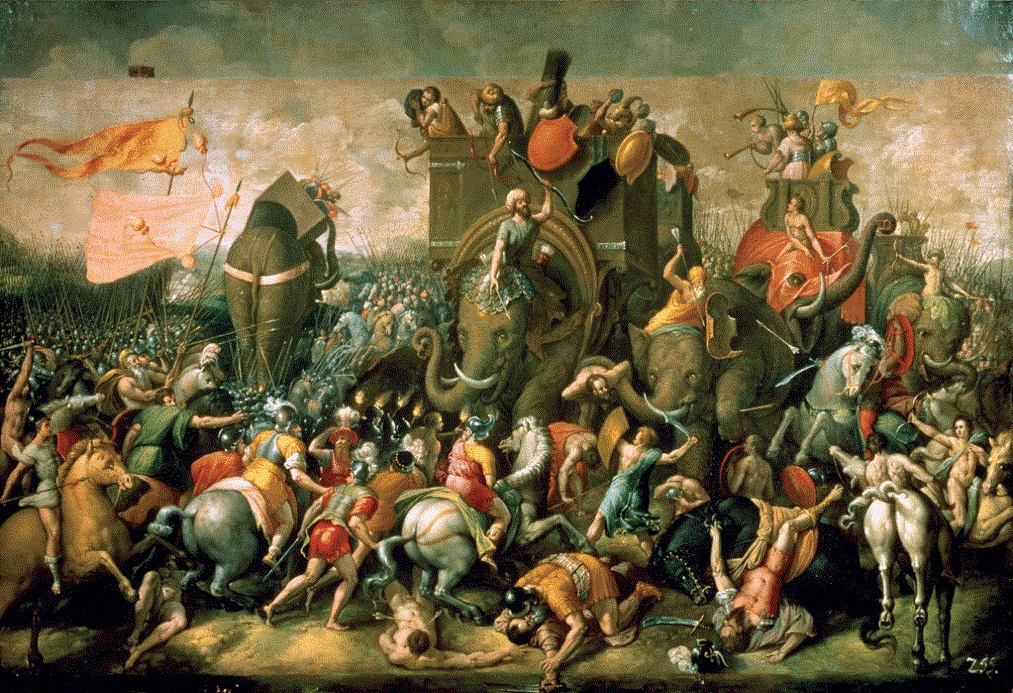
Ciceronian Speech Information

Principal Rhetorical and Literary Devices
1. Alliteration: repetition of the same letter at beginning of words or syllables: Marcus me momordit.
2. Anaphora: the repetition of a word or phrase for emphasis: non feram, non sinam, non patiar
3. Anastrophe: inversion of usual word order (e.g., preposition after the word it governs): te propter vivo (instead of the expected propter te vivo)
4. Aposiopesis: breaking off in the middle of a sentence : quem ego . . . sed non possum pergere. ("Whom I . . . but I cannot go on.")
5. Apostrophe: addressing a person who is not present: O maiores, quid diceretis de hac re? ("Oh ancestors, what would you say about this matter?")
6. Asyndeton: omission of conjunctions: videt, sentit, scit.
7. Chiasmus: "a-b-b-a" arrangement of words: magnas urbes oppida parva (adjective, noun, noun, adjective)
8. Ellipsis: omission of words: Dixit me inventum. ("He said I had been found." esse is missing).
9. Hendiadys: use of two nouns together to express a noun modified by an adjective: luctus et labor (meaning "grievous toil")
10. Hyperbole: exaggeration. Catilina est mons vitiorum. ("Catiline is a mountain of vices.")
11. Hysteron proteron: placing first what the reader might expect to come last mortuus est et hostem inruit ("He died and he rushed against the enemy")
12. Litotes: use of a negative to express a strong positive Haud stultus erat Cicero. ("Cicero was very intelligent").
13. Metaphor: expression of meaning through an image Horatius est lux litterarum Latinarum. ("Horace is the light of Latin literature.")
14. Metonymy: substitution of one word for another that it suggests Neptunus me terret (to mean, "the sea frightens me").
15. Onomatopoeia: use of words that sound like their meaning Murmurant multi (the "m"’s produce the sound of murmuring).
16. Oxymoron: use of an apparent contradiction parvum monstrum
17. Personification: attribution of human characteristics to something not human Ipsa saxa dolent. ("The rocks themselves grieve")
18. Pleonasm: use of superfluous words Oculis me videt. ("She sees me with her eyes.")
19. Polysyndeton: use of many conjunctions et videt et sentit et scit
20. Prolepsis (anticipation): use of a word sooner than it would logically appear submersis obruit puppis ("he overwhelms the sunken ships").
21. Simile: comparison using a word like sicut, similis, or velut. Volat sicut avis. ("He flies like a bird.")
22. Synecdoche: use of part to express a whole Prora in portam navigavit. ("The ship sailed into the harbor." prora [prow] for navis [ship]).
23. Tmesis: the separation of a compound word into two parts saxo cere comminuit brum (for saxo cerebrum comminuit: "He smashed his brain with a rock.").
24. Tricolon crescens (ascending tricolon): combination of three elements, increasing in size non ferar, non patiar, non tolerabo
25. Zeugma: use of one word in two different senses simultaneously Aeneas tulit dolorem et patrem Troia. (Aeneas carried grief and his father from Troy)
Subscribe to:
Posts (Atom)