Link to the Plutarch reading on Alexander
ALEXANDER was the son of Philip, King of Macedon, and at a very early age showed that he had the spirit of a warrior. His father won many brilliant victories, but, instead of rejoicing at them, Alexander would say to his friends, "My father will go on conquering until nothing extraordinary be left for you and me to do." He never cared for pleasure or riches, but thirsted for glory, and therefore hoped to inherit a kingdom that was plunged in wars, so that he might be able to exercise his courage.
The care of his education was given to several instructors, but Leonidas, a kinsman of his mother, presided over them all. Lysimachus was his chief preceptor, but he was neither a good nor an able man. Philip therefore soon secured the services of a great philosopher, because the following circumstance convinced him that his son was worthy of every advantage.
A horse, Bucephalus by name, was offered to Philip for the sum of thirteen talents, or about thirteen thousand dollars of our money, and the king, with the prince and many others, went to the field to see him tried. He proved to be so vicious and unmanageable that none of the grooms dared venture to mount him. Philip was displeased at any one's having brought him such an animal, and angrily ordered him to be taken away. Alexander was, on the contrary, so delighted with the fine points he observed in the horse that he exclaimed, "What a horse are they losing for want [212] of skill and spirit to manage him!" Philip did not at first notice the boy, who made several such remarks. At last he said, "Young man, you find fault with your elders, as if you knew more than they, or could manage the horse better." "I certainly could," answered the prince. "If you should not be able to ride him; what will you forfeit for your rashness?" "I will pay the price asked for him." Everybody laughed; but, having gained his father's permission, Alexander ran to the animal, and, laying hold of the bridle, turned his head to the sun. He did this because he had observed that the continually-moving shadow of himself annoyed Bucephalus. Then he spoke softly to the animal, and stroked him gently until he grew calm; after which he leaped lightly on his back and seated himself. Having accomplished that much, he jerked the bridle gently, and Bucephalus started forward without the use of whip or spur. Philip and his courtiers looked on in anxious silence; but when the prince turned the horse and rode straight back to the spot whence he had started, he was received with loud shouts, while the father, with tears in his eyes, embraced him and said, "O my son, seek another kingdom worthy of thy abilities, for Macedonia is too small for thee."
It was immediately after this that Aristotle, the most celebrated and learned of all the philosophers, was engaged to instruct Alexander. The boy soon learned to love his master almost as much as he did his own father, and in after-years he would say, "From my father I derived the blessing of life, but from Aristotle the blessing of a good life." Alexander was born with a love for study, which never left him to the very end of his life. He was only sixteen years old when his father went from home on an expedition and left him regent of Macedonia, and keeper of the royal seal. He did not remain idle, but reduced a rebellious tribe, took their chief town by storm, planted a mixed colony there, and called the place Alexandropolis after himself. At the battle of Chæronea this young prince charged and broke the Theban Sacred Band, and had the glory of being the first who had ever done that.
King Philip was preparing for a war against Persia, B.C. 336, when he was assassinated. Alexander, who was just twenty years of age, succeeded to the throne. The kingdom he was called upon to rule was in a most unsettled condition; for, by his numerous [213] victories, Philip had subdued Greece, but she had not become accustomed to the yoke, consequently the whole country was in a tumultuous state.
Alexander's counsellors advised him to give up Greece entirely, but he would not listen to them, particularly as several of the states, thinking they had nothing to fear from so young a sovereign, showed signs of rebellion. He marched without delay as far as the Danube, where he fought a great battle with the Triballi and defeated them.
Shortly after he was informed that the Thebans and the Athenians had revolted, so he advanced immediately through the pass of Thermopylæ, saying, "Demosthenes called me a boy while I was among the Triballi, a stripling when in Thessaly; but I will show him before the walls of Athens that I am a man."
The Thebans made a desperate resistance, and the war began with great fury; but the Macedonians had such a large army that they surrounded Thebes on all sides and completely destroyed it. Among the inhabitants, the priests and the poet Pindar were spared, but thirty thousand were sold as slaves, and more than six thousand were killed in the battle.
Some of the scenes enacted are too horrible to recount, but an anecdote about Timoclea, a woman of rank and wealth, is worth repeating. A party of Thracians entered her house and carried off all the valuables it contained, but, not satisfied with that, the captain asked whether she had not some gold and silver hidden away. "Oh, yes," she said, leading him to a well in her garden; "when the city was taken I threw all my jewels and money down there." The captain stooped to examine the well, whereupon Timoclea pushed him in and threw all the heavy stones she could find on top of him. The soldiers seized her, bound her hands, and led her before Alexander, to whom they told what she had done.
"Who are you?" asked the king.
"I am the sister of Theagenes, who, as general of our army, fought Philip for the liberty of Greece and fell in the battle of Chæronea," she replied, boldly.
Alexander could not help admiring her bravery, nor could he blame her action, seeing that she was dealing with an enemy, therefore he commanded her and her children to be set at liberty. The [214] rest of the Greek nations were so impressed by the fate of Thebes that they gladly came over to the Macedonian party, and soon after chose Alexander for their general when their war with Persia began.
They were assembled at Corinth for this election, and most of the public officers and philosophers of the neighborhood went to visit Alexander and offer their congratulations. But there was one who took no notice of him whatever, and that was Diogenes of Sinope, then living at a little place just outside of Corinth called Cranium. So Alexander went to see the philosopher, whom he found lying in the sun. At the approach of so many people he looked up, and the king in a friendly tone asked, "Is there any way in which I can serve you?"
"Yes; I would have you stand from between me and the sun," replied the philosopher.
Alexander was struck with surprise, for he did not suppose there was a man in the world so contented as to require no service at his hands. His courtiers were annoyed and called Diogenes a monster, but the king said, "If I were not Alexander I should wish to be Diogenes."
After consulting the oracle and receiving for answer, "My son, thou art invincible," Alexander set out with an army of four thousand five hundred horse and thirty thousand foot-soldiers. On his arrival at Troy, he sacrificed to Minerva, anointed the tomb of Achilles with oil, then put a garland on it, and congratulated the dead hero on his good fortune in having such a friend as Patroclus and such a poet as Homer to sing his praises.
Alexander moved so rapidly that he took the army of Darius by surprise, and got as far as the river Granicus, in Asia, without meeting any opposition. He advanced under showers of darts thrown from the steep opposite banks, which were covered with the enemy's troops, and having climbed the muddy, slippery paths, engaged in a hand-to-hand fight, and won a decisive victory. Alexander was attacked several times, and had a horse killed under him, but, although he was easily known by his waving white plumes, he escaped without a wound.
The loss on the Persian side was very heavy, while their conqueror had no more than sixty horse and thirty foot-soldiers killed. [215] Among these were twenty-five of Alexander's personal friends, and to do honor to their memory he erected a brass statue to each. The Grecians got a share of the spoils, particularly the Athenians, to whom he sent three hundred bucklers. Upon the rest he ordered this inscription to be placed: "Alexander, the son of Philip, and the Grecians, except the Lacedæmonians, won these from the barbarians who inhabit Asia." All the plate, purple garments, and ornaments that he took from the Persians, except a small quantity that he kept for himself, he sent as a present to Olympias, his mother.
Alexander was so elated with this victory that he did not rest until he had freed all the Greek cities in Asia Minor from the Persian yoke. Then, on hearing of the death of Memnon, the principal commander of Darius, he determined to march to the upper part of Asia. A serious and dangerous illness, caused by a cold bath in the river Cydnus, detained him, however. Possibly he might have been cured in a few days if he had not been a king, but his physicians were afraid to try severe remedies, lest they might not have the desired result and thus subject themselves to suspicion and probably punishment. Philip, one of the physicians, who loved Alexander exceedingly, thought it shameful when his master was in danger not to risk something, so he took upon himself the cure, and set to work to prepare the medicine.
Before it was ready, one of his commanders sent the king a letter bidding him beware of Philip, who had been bribed by Darius to poison him. Having read the letter, Alexander put it under his pillow without showing it to anybody. He had perfect confidence in Philip, of which he gave proof when the medicine was brought; for, placing the cup to his lips, he swallowed the dose even while the physician read the letter which he handed him. Philip was indignant at the unjust charge, and threw himself down by the bedside, entreating his master to have courage and trust to his care. In about three days the invalid was so much better as to be able to show himself to the Macedonians, whose anxiety had been very great on his account.
Darius did not know that illness detained Alexander, and he made up his mind that it was fear; he therefore marched forward to Cilicia with his army. This was a mistake, because he had to fight [216] in narrow passages, where his immense forces were so cramped that they could scarcely obey orders, whereas had he remained in Assyria he would have met Alexander on wide, open plains; but he paid dearly for his error, and suffered a signal defeat. He lost over a hundred thousand men, and came very near being captured himself. However, he escaped, though his chariot and bow fell into the hands of the conqueror, who returned with them in triumph to his soldiers.
The Persian camp was filled with rich armor and clothing, of which the Macedonian soldiers took possession; but they did not touch the tent of Darius. That they reserved for Alexander, who found in it richly-clothed officers of the royal household, magnificent furniture, and great quantities of gold and silver.
Having laid off his armor, the conqueror said to those about him, "Let us go and refresh ourselves after the fatigue of the battle in the baths of Darius." "Nay, rather in the baths of Alexander," said one of his friends, "for the goods of the conquered are and should be called the conqueror's."
When Alexander looked about and beheld the basins, boxes, vials, vases curiously wrought in gold, the splendid and luxurious lounges and cushions, and smelled the fragrant essences, he turned to his friends and asked, "Can it be possible that a king finds happiness in such enjoyments as these?"
At that period Alexander had not been spoiled by Persian luxury, and his tastes were extremely simple. His table was always splendidly and plentifully supplied, but he did not care for delicacies, and frequently left them untouched, though he was careful to see that his guests were treated to the very best the market afforded. Some historians have accused him of drinking to excess, but this is a mistake arising from his habit of sitting a long time at table. This arose from his fondness for conversation, for with every cup of wine he would discourse at length on some subject or other, and never indulged in this pleasure unless he had ample leisure. When he was busy he would neither eat, sleep, nor drink; otherwise he could not in his short life have performed so many great actions. Much of his leisure was spent in hunting, throwing the javelin, and otherwise exercising, or reading and writing. As his fortune increased his feasts became more magnificent, until each [217] cost no less than ten thousand drachmas. These feasts always lasted many hours, because they were lengthened out by conversation, in which art Alexander surpassed most other princes.
He showed great kindness of heart in his treatment of Darius's family after the defeat of that monarch in Cilicia. As he was sitting down to dine, when the battle was over, he was told that among the prisoners were the mother, wife, and two daughters of Darius, all of whom were bowed down with grief because, as they saw the royal chariot among the spoils, they concluded that the king was dead. Alexander felt very sorry for the poor captives, and after a few moments' thought sent Leonatus to them with this message: "Assure them that Darius is not dead; that they have nothing to fear from Alexander, for his dispute with Darius was only for empire, and that they shall find themselves provided for in the same manner as when Darius was in his greatest prosperity."
He kept his promise in every particular, and not only were the captives allowed to do funeral honors to what Persians they pleased, but they were furnished for that purpose with all the necessary robes and other decorations out of the spoils. Besides, they were provided with as many domestics as they needed, and all the comforts and luxuries they had ever enjoyed; no soldier dared to obtrude upon their privacy, and they soon lost sight of the disagreeable fact that they were in an enemy's camp.
Alexander did not follow the Persian monarch, but took possession of Damascus, which contained a large portion of the royal treasure, and conquered all the towns along the Mediterranean Sea. Tyre refused to submit, and was therefore besieged. While the siege lasted, Alexander dreamed that Hercules offered him his hand from the wall and invited him to enter, which was considered a favorable sign. Some of the Tyrians dreamed that Apollo told them he was displeased with their behavior, and was about to leave them and go over to Alexander. So they seized the statue of the god, loaded it with chains, and fastened the feet to the pedestal, to prevent his becoming a deserter. At the end of seven months the siege was suddenly brought to a close in this way: One of Alexander's soothsayers, after offering sacrifices, examined the entrails of the victim, and proclaimed, "The city shall be taken this month." "How can that be," asked the soldiers, [218] "this being the very last day of the month?" Thereupon Alexander answered by ordering that it should be called the twenty eighth, not the thirtieth, and so sounded the trumpets for an onslaught. It proved the most violent attack that had been made, and the soothsayer's prophecy came true, for the city of Tyre fell that day.
Then Alexander proceeded on his victorious march through Palestine until he reached Gaza, one of the largest cities of Syria which, after a siege, shared the fate of Tyre. From there he sent presents to his mother and all his friends. To Leonidas, his early tutor, he forwarded a great load of frankincense and myrrh, because once when offering sacrifices he had been so extravagant with those spices that Leonidas had said, "Alexander, when you have conquered the country where spices grow you may be thus liberal of your incense; but, in the mean time, use what you have more sparingly." So, when he sent the present from Gaza, Alexander wrote, "I have sent you frankincense and myrrh in abundance, that you need no longer be stingy with the gods."
One day a magnificent casket that had belonged to Darius was brought to him, and he asked his friends what they thought the most worthy thing to place in it. One suggested one article, another something else; but he said, "No, Homer's Iliad most deserves such a case," and from that time his copy of that work was kept in the costly box.
In Egypt, Alexander was received as a deliverer, because the inhabitants were tired of the Persian yoke and glad of a chance to throw it off. Alexander restored their former customs and religious rites, and founded Alexandria, which became one of the most important cities of ancient times.
Thence he made a journey through the desert of Libya to consult the oracle, Jupiter Ammon. Few men would have started upon so long and dangerous a journey without misgivings, for there was likely to be scarcity of water, and violent winds that would blow about the poisonous sand of the desert and cause the death of those who inhaled it. But Alexander was not to be turned from anything he was bent upon; besides, he had known nothing but good fortune all his life; he was therefore bold. The gods seemed to favor him as usual, for plentiful rains fell, which not only re- [219] lieved the soldiers from fear of drought, but made the sand moist and firm and purified the air. Besides, some ravens kept up with the Macedonians in their march, flying before them and waiting for them if they fell behind; but the strangest part of all was, that if any of the company went astray in the night, the ravens never ceased croaking until they were guided to the right path again.
When Alexander had passed through the wilderness and arrived at the place, the high-priest of Ammon bade him welcome in the name of the god, and called him son of Jupiter. "Have any of the assassins of my father escaped me?" asked Alexander. "Do not express yourself in that manner," said the priest, "for your father was not a mortal."
"Well, then, are all the murderers of Philip punished? and am I to be the conqueror of the world?" asked Alexander. "That high distinction you shall have, and the death of Philip is fully revenged," was the answer.
Alexander was so pleased at what he had heard that he made splendid offerings to Jupiter, and gave the priests presents of great value. But he put on a lofty bearing after being addressed as the son of Jupiter. Some people think that he did this among the Persians only to make them honor and respect him, for once, when he was wounded with an arrow, he said to those about him, "This, my friends, is real, flowing blood, not such as the immortal gods shed."
In course of time Darius wrote to Alexander proposing terms of peace, and offering ten thousand talents as a ransom for his captives, all the countries on this side the river Euphrates, and one of his daughters in marriage. Parmenio, a friend of the Macedonian king, said, "If I were Alexander I would accept those terms." "So would I if I were Parmenio," replied the king. At the same time he sent this message to Darius: "If you will come to me, you shall find the best of treatment; if not, I must go and seek you." And so he began his march. But he had gone only a little way when news was brought to him of the death of Darius's wife. He felt very much grieved at this sad event, and returned to bury the dead queen in a style befitting her rank. Tireus, one of the slaves of the bed-chamber, was at once sent to carry the news to Darius, who, in the midst of his lamentations, [220] was somewhat comforted at the assurances Tireus gave him of the care, respect, and attention that had been shown his family. After hearing all that the Macedonian king had done for them, he raised his hands towards heaven and said, "Ye gods, grant that I may reestablish the fortunes of Persia and leave them as glorious as I found them; grant that victory may put it in my power to return to Alexander the favors which my dearest ones have received from him. But if the time determined by fate and the divine wrath is now come for the glory of the Persians to fall, may none but Alexander sit on the throne of Cyrus!"
When spring returned, Alexander, having subdued all the country on this side the Euphrates, began his march against Darius, who had collected an army of a million of men. The Macedonians did not number half so many; nevertheless, Alexander felt no doubt of his success. But when some of his chief officers beheld the Persian troops covering a vast field, they felt so anxious that they begged their monarch to attack Darius by night. "Oh, no," he replied; "I will not steal a victory." This answer did not imply any trifling with danger, for Alexander knew there was much to fear; but he foresaw that in case Darius was overcome in the darkness of night it would afford him an excuse for trying his fortune again.
After giving this answer, Alexander went to bed in his tent, and slept so soundly that Parmenio was obliged to give the soldiers orders to take their breakfast and then to arouse Alexander, for there was not much time to lose. "How is it possible for you to sleep so soundly when you are on the point of fighting the most important of all our battles? One would suppose that we were already victorious." "And are we not so indeed," asked Alexander, "since we are at last relieved from the trouble of wandering in pursuit of Darius?"
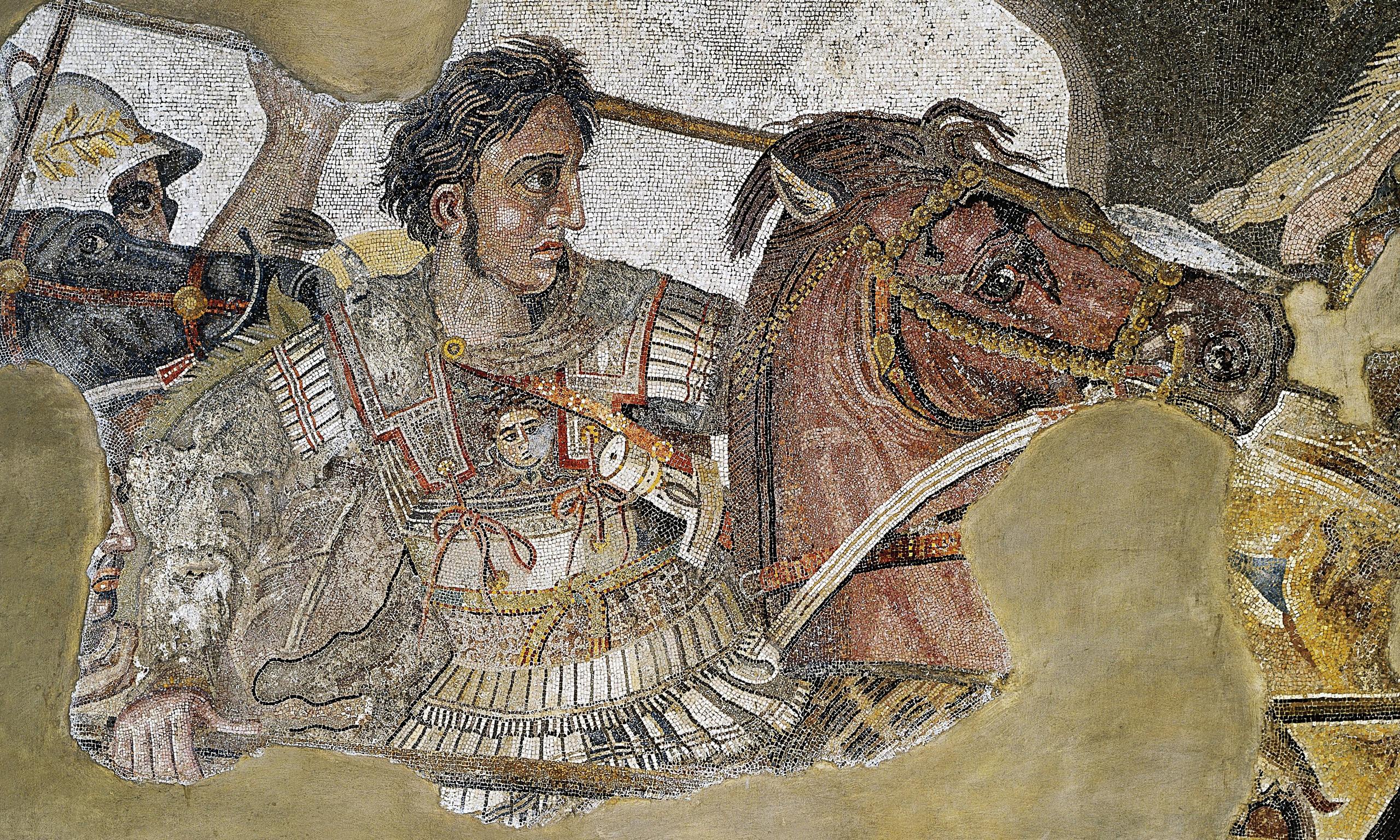
So, with a display of eagerness for the fight, the great warrior buckled on his armor and left his tent. This is how he appeared: he wore a short coat of Sicilian cut that fitted close to his figure, and over that was a thickly-quilted breastplate of linen, which had been taken among the spoils of the last battle. His helmet was of iron, beautifully wrought, and so highly polished that it shone like silver; to this was fitted a piece of armor called a gorget, that pro- [221] tected the neck and throat, set with precious stones. His sword was of the best tempered steel and very light, and his belt of the most superb workmanship. When drawing up his army and giving orders before a battle, Alexander never rode Bucephalus, because he was getting old and had to be saved for battles; but he always charged upon that fiery steed, and gave the signal as soon as he was mounted.
Alexander made a long speech to the Greeks, who answered with loud shouts and begged him to lead them on. Then, raising his right hand towards heaven, he exclaimed, "If I be really the son of Jupiter, defend and strengthen the Greeks, ye gods!" Just then his chief soothsayer, who rode by his side in a white robe with a crown of gold upon his head, pointed to an eagle that soared above and directed his course towards the enemy. This was a favorable omen: the cavalry charged at full speed, and the phalanx rushed on like a torrent.
That day witnessed one of the most furious battles that ever was fought in the world, and in the very face of danger Alexander showed the same coolness, courage, and good judgment throughout. The Persians fought bravely too, and fortune favored them at times; but it so happened that Alexander threw a dart at Darius, who, being the tallest and handsomest man in his army, could easily be distinguished. The dart missed him, but killed his charioteer on the spot, whereupon some of the guards raised a loud cry, and those behind, thinking the king had been killed, fled. The troops in front were driven back, and the wheels of the royal chariot became so entangled among the dead bodies that the horses plunged and darted without being able to move forward or back. Throwing down his arms, Darius jumped from the chariot, mounted the nearest horse, and fled for his life. But he would not have escaped, for Alexander was anxious to capture him, and might have done so had it not been for Parmenio, who at that moment sent for his assistance.
Alexander was vexed at being stopped, but when he was riding to the part of the army that had called for him, he was informed that the enemy were totally defeated and put to flight. So the Persian army, baggage, tents, and immense treasures, fell into the hands of the victor. Alexander was now proclaimed king of Asia, [222] and the first thing he did was to make magnificent sacrifices to the gods and presents of large sums of money and offices to his friends.
Indeed, Alexander was always noted for his generosity to his friends, and he carried this trait so far that his mother wrote him, "You make your friends equal to kings by giving them the power of getting any number of friends of their own, while you leave yourself destitute." He took no notice of this remonstrance, for he never allowed his mother to meddle in matters of state or war, although he always showed her great respect, and treated her with even more generosity than he showed to others.
Alexander seated on the throne of Darius was a gratifying spectacle to the Greeks, but from that time the warrior's glory grew dim, for no sooner was he master of the greatest empire in the world than he began to indulge his passions, and gave himself up to all sorts of dissipation. It was in a fit of intoxication that he set fire to the magnificent palace of the Persian kings, which was filled with valuable treasures, and burned it to the ground. But when he became sober, he was so ashamed of this act that he set out at once with his cavalry in pursuit of Darius.
He made a long and painful march of eleven days, during which his soldiers suffered so much from want of water that they were loath to continue. About noon one day a party of Macedonians came up to Alexander. They were on mules, and carried vessels filled with water. One of them, seeing the king almost choking from thirst, filled a helmet with water and offered it to him. He took it in his hands, then looked about at the faces of his suffering soldiers, who wanted refreshment just as much as he did, and said, "Take it away, for if I alone should drink, the rest will be out of heart, and you have not enough for all." So he handed back the water without having touched a drop of it, while the soldiers applauded the hero, jumped on their horses, and demanded to be led forward.
Alexander had heard that Darius was kept a prisoner by Bessus, and hoped to save him, but when Bessus found himself in danger from the approaching army, he ordered the king to be assassinated. Polystratus was the first officer who beheld the dying monarch, as he lay on a chariot by the roadside, covered with wounds. He asked for water, which was handed to him, then he said, "It has [223] become the last extremity of my ill fortune to receive benefits and not be able to return them. But Alexander will recompense thee, and the gods will reward Alexander for his humanity to my mother, my wife, and my children. Tell him I give him my hand, for I give it to thee in his stead." So saying, he took the hand of Polystratus and expired. When Alexander came up, he shed tears, and, taking off his own cloak, threw it over the body, which was afterwards laid in state.
Somewhat later Bessus was captured, and this is how he was punished: two straight trees were bent, and one of his legs was made fast to each, then the trees were allowed to return to their former position, and the body was torn in two.
Once a party of barbarians fell upon some Macedonians who had Bucephalus in charge, and captured him. Alexander was so provoked at this that he sent a herald to tell them that if they did not immediately return the horse he would kill every man, woman, and child in their country. Bucephalus was brought back, and the barbarians surrendered their cities, but they were treated with great kindness.
Alexander next marched into Parthia, and in order to gain the affection of the people he dressed like a Persian and adopted their manners, though at the same time he introduced to them some of the Macedonian customs. Besides, he married Roxana, an Asiatic lady of great beauty, whom he loved devotedly. This added more to his popularity in Persia than anything else.
Parmenio, who has been mentioned several times, was Alexander's principal general and a man of great ability. He had a son named Philotas, who for valor and endurance in time of war was next to the monarch himself. But Philotas had fallen into the habit of boasting so much of his exploits that his father took him to task for it several times, and his friends became envious not only of his deeds, but of the favors that were constantly shown him at court. So when a plot was discovered against the life of the Macedonian king, any trifling word or sign that might tend to cast suspicion on the favored officer was eagerly repeated to Alexander. As nothing could be proved, it was decided to put Philotas to the torture, the monarch hiding himself behind a tapestry to hear what might be forced from his lips. The victim lamented so much, and [224] begged so hard for his life, that Alexander cried out, "O Philotas, with all this unmanly weakness, how didst thou dare engage in so great and dangerous an enterprise?" He was put to death and Parmenio also, although the latter had been the prime mover in the expedition into Asia, and had been a loyal, valiant soldier for many years. This unjust deed made Alexander terrible to his friends, and the fate of Clitus was not less shocking to them.
Clitus had been one of Alexander's bravest officers and most faithful friends, and this is what happened to him. Some very fine fruit had been brought from Greece to the king, who was so pleased with it that he invited Clitus to supper that he might enjoy it also. The company drank freely, and became quite lively as the meal proceeded; but towards its close one Pranicus began to sing a song that had been written in ridicule of the Macedonian officers, who had recently been beaten by the barbarians. The older men present felt offended, and condemned both the poet and the singer; but Alexander laughed and bade Pranicus repeat the song. Clitus, who was under the influence of wine, said, angrily, "It is not well done to make a jest of Macedonians among their enemies, for, though they have met with misfortune, they are better men than those who laugh at them."
"Clitus pleads his own cause when he gives cowardice the soft name of misfortune," said Alexander.
Clitus started up as if he had been stung, and cried, "Yes, it was cowardice that saved you, son of Jupiter, as you call yourself, when you turned your back to the sword of Spithridates. It is by the blood of the Macedonians and these wounds that you are growing so great as to disown Philip for your father and pass yourself off for the son of Jupiter Ammon."
Irritated at these bold words, Alexander replied, "Thou shameless fellow! dost thou think to say such base things of me, and stir the Macedonians up to sedition, and not be punished for it?"
"We are already punished," rejoined Clitus. "What reward have we for all our toils? Do we not envy those who do not live to see Macedonians bleed under Median rods, or sue to Persians for access to their kings?"
Thus one word led to another, until, unable longer to control his drunken rage, the king picked up an apple and threw it in the face [225] of Clitus, who then looked about for his sword. But one of his guards had prudently removed it, while the older men gathered about the irate king and begged him to compose himself.
Meanwhile, Clitus had been dragged out of the room, but he returned by another door, singing loudly some insulting verses. Then it was impossible to restrain the king any longer; he snatched a spear from one of his guards, rushed towards Clitus just as he raised the curtain to enter, and ran him through the body. He fell to the ground, groaned, and expired.
Then Alexander felt very sorry for what he had done, for he had loved Clitus, and he became sober as soon as he beheld him dead at his feet. For a moment he gazed in silence, then hastily drawing the spear out of the body was about to run it into his own throat, when the guards seized it and led him by force to his chamber. He passed that night and the next day plunged in grief, uttering now and then a pitiful moan, but speaking to no one. Several philosophers sought to console him, but failed. At last Anaxarchus entered, and exclaimed in a loud tone, "Is this Alexander upon whom all the world is looking? Can it be he who lies on the ground crying like a slave, in fear of the law and the tongues of men? He himself should be the law to decide right and wrong. What did he conquer for but to rule and command? Know you not, Alexander, that Jupiter is represented with justice and law by his side to show that all the actions of a conqueror are right?"
The king was pacified by these soothing words, and his conscience ceased to be disturbed, but he became more unjust and haughty than ever, for he was only too ready to believe, as the philosopher had said, that whatever he might choose to do was right. Thus was this great hero thoroughly spoiled by the flattery of those who surrounded him.
But he was not yet prepared to rest; he had made up his mind to conquer India, a country little known at that time. After he had passed the Indus he formed an alliance with Taxilus, who ruled the region beyond the river and furnished troops and a hundred and thirty elephants for the Macedonian king. With this addition to his army Alexander marched against King Porus, who defended the river Hydaspes with his troops. A bloody battle ensued, and Alexander came off victorious.
[226] While fighting, King Porus rode on one of the largest of his elephants, but he was such an enormous man that the proportion was about the same as between a man of medium height and a horse. The elephant that Porus rode was an intelligent animal, that took great care of his master during the battle, several times preventing him from falling off when he was hit, and at the close kneeling down slowly and with his trunk pulling out every dart that stuck in his body.
Porus was taken prisoner and led before Alexander. "How do you desire to be treated?" asked the latter.
"Like a king," was the reply.
"And have you nothing else to ask?"
"No; everything is included in the word king," said Porus. Alexander was pleased with his bearing and his replies, and not only restored to him his kingdom, but added extensive territories to it besides.
It was in the battle with Porus that Bucephalus received wounds which caused his death soon after. Alexander showed much regret at the loss of this faithful friend, and built a city where he was buried, which he called Bucephalia.
Seventy Greek towns were founded by Alexander as he marched along, and he was so elated by success that he resolved to go as far as the river Ganges; but his army refused to march farther, and he was forced to return. He built a fleet on the Hydaspes, and as he travelled with his troops met several Indian princes in battle. He laid siege to the town of Malli, where he was the first to mount the scaling-ladder; but it broke, and he was left on the wall alone, a target for the darts which were showered at him from below. He hesitated for a moment, then jumped down in the midst of the enemy. Fortunately, he fell on his feet, and the flashing of his armor so frightened the Mallians, who thought it was lightning proceeding from his body, that they turned and fled. That gave time for some of his guard also to jump down from the walls; but the enemy recovered from their astonishment and returned. A hand-to-hand attack ensued, and Alexander was wounded through his armor, although he fought desperately. Other wounds brought him to his knees, and he would have been despatched had it not been for his two guards, who placed themselves before him. One of [227] them was wounded and the other killed. A tremendous blow with a bludgeon on the back of the neck struck Alexander senseless, but the Macedonians, who by that time had flocked within the walls, gathered about him and carried him to his tent. It was reported that he was dead, but in course of time he recovered, and there was great rejoicing in his army when he again appeared among them. After offering sacrifices to the gods he continued down the river, and subdued a vast deal of country as he coasted along.
Among other prisoners, he took ten philosophers called Gymnosophists, who had urged a prince named Sabbas to revolt against the Macedonians. These Gymnosophists always went naked, differing in this as well as in other particulars from the ordinary philosophers. One of their customs was to discuss learned subjects while they dined, and when they assembled not only they, but all their pupils, even the youngest, were questioned as to what good they had done during the day, and those who had not some kind action or some useful occupation to tell of, were allowed no dinner.
Well, on hearing that the ten philosophers he had captured were remarkable for the answers they always gave, even to the most obscure questions, Alexander determined to try them, first announcing that he would put to death the one of them who answered worst, and after him all the rest. The oldest man among the Gymnosophists was appointed judge.
"Which are more numerous, the living or the dead?" he asked of the first. "The living; for the dead no longer exist," was the answer.
"Does the earth or the sea produce the largest animals?" the second was asked. He answered, "The earth; for the sea is part of it."
Alexander's question to the third was, "Which is the cunningest of beasts?" "That which men have not yet found out," he said.
He ordered the fourth to tell him what argument he used to persuade Sabbas to revolt. "No other," he answered, "but that he should either live or die nobly."
Of the fifth he asked, "Which is the older, night or day?"
The philosopher replied, "Day is older, by one day at least;" and noticing that Alexander was not satisfied, he added, "You ought not to wonder if strange questions draw forth strange answers."
[228] "What should a man do to be exceedingly beloved?" asked the king of the sixth. "He must be very powerful, without making himself too much feared," was the reply.
"How may a man become a god?" was the question to the seventh philosopher. "By doing that which is impossible for me to do."
"Which is stronger, life or death?" the eighth was asked "Life, because it bears so many evils."
"How long is it good for a man to live?" "As long as he does not prefer death to life," said the ninth philosopher.
Then turning to the judge, Alexander ordered him to pass sentence. The old man said, "In my opinion each has answered worse than the other."
"Then thou shalt die first for giving such a sentence," said Alexander.
"Not so, O king, unless you said falsely that he should die first who made the worst answer," returned the oldest Gymnosophist. The king was so amused that he gave them a great many presents, and sent them away.
Alexander spent seven months on the rivers, and at the end of that time war, illness, caused by bad food and excessive heat, and famine had destroyed three-quarters of his army, and he was glad to return to Persia. When passing through that country he had about him everything that was beautiful and luxurious, and spent much of his time in feasting. At one of his suppers he promised that the man who drank most should be crowned with victory. Promachus won the crown, for he drank about fourteen quarts of wine, but he lived only three days afterwards, and forty-one others died from the quantity they drank on that occasion.
When Alexander reached Susa he married Statira, the daughter of Darius, and his officers followed his example, each marrying a Persian lady. Then he gave a grand entertainment in honor of these events. He had no less than nine thousand guests, and presented each with a golden cup, and everything was arranged with such magnificence as had never been seen at a feast before.
After that Alexander offered splendid sacrifices, and gave a number of sumptuous banquets; but there were repeated bad omens, both in the appearance of the victims of the sacrifices and [229] in other circumstances, all of which made Alexander so superstitious that he was ready to listen to any interpretation made by his numerous soothsayers, even of the most trifling and natural events. He became sad and dejected, but one day he roused himself and gave another feast, then took a bath and went to bed. The next day and night he drank so hard that a fever came on, and the more he drank the more ill he became, until delirium ensued, and at the end of thirteen days he died.
This great conqueror lived only thirty-two years, and reigned less than thirteen. He left an immense empire, which became the scene of many bloody wars. He was buried in the city of Alexandria. A golden coffin received his remains, and divine honors were paid to his memory in Egypt, as well as in other countries.
No character in history has offered more matter for discussion than that of Alexander the Great; but from the short account given here our young readers may form their own opinions, and perhaps feel encouraged to investigate for themselves.