Please begin reviewing the linked materials and collecting ideas for your viva answers.
Solon
Lycurgus
Pericles
Thursday, October 15, 2015

Friday, October 9, 2015
Week 8
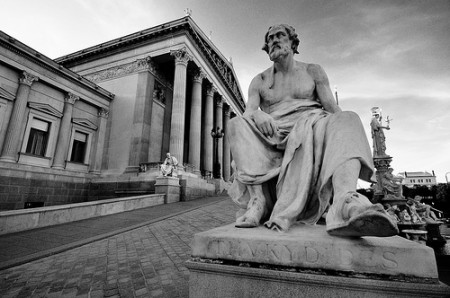
THUCYDIDES (460-400 BC)
THE AUTHOR OF "THE PELOPONESSIAN WAR"
Thucydides the son of Olorus was born probably about 460 BC and died about the year 400 BC. When the Peloponnesian War broke out in 431 B.C Thucydides probably took part in some of its early actions. Some time between 430 and 427 he fell ill in the plague, but recovered. In 424 he was appointed general, but his small squadron of ships arrived too late to save the important Athenian colony of Amphipolis from the Spartan commander Brasidas, though he successfully held the nearby port of Eion against Brasidas's attacks. In consequence he was exiled, not returning until twenty years had passed, only to die a few years later.
For much of the period he describes The Peloponnesian War is the only source that survives. The verity of his reports and the justice of his perceptions have been the cause of controversy amongst scholars for centuries. But it is certain that he used his historical imagination to reconstruct only as a last resort. When the various parts of the history were composed, which of these he revised, and whether their chronological inconsistencies are due to later editing — these questions are still unsolved.
Week 8

The so-called golden age of Athenian culture flourished under the leadership of Pericles (495-429 B.C.), a brilliant general, orator, patron of the arts and politician—”the first citizen” of democratic Athens, according to the historian Thucydides. Pericles transformed his city’s alliances into an empire and graced its Acropolis with the famous Parthenon. His policies and strategies also set the stage for the devastating Peloponnesian War, which would embroil all Greece in the decades following his death.
PERICLES: RISE TO POWER
Pericles was born into one of Athens’ leading families. His father Xanthippus was a hero of the Persian War and his mother belonged to the culturally powerful Alcmaeonidae family. He grew up in the company of artists and philosophers—his friends included Protagoras, Zeno and the pioneering Athenian philosopher Anaxagoras. Pericles’ earliest recorded act, the financial sponsorship of a play by Aeschylus in 472 B.C., foreshadowed the future leader’s wealth, artistic taste and political savvy. The play expressed support for Athens’ embattled populist leader Themistocles over Pericles’ future archrival, the aristocrat Cimon.
Between 463 and 461 Pericles worked to prosecute and eventually ostracize Cimon for allegedly betraying Athens and emerged as the leader of Athens’ democratic party. In 454 he led a successful military campaign in Corinth and sponsored the establishment of Athenian colonies in Thrace and on the Black Sea coast. In 443 he was elected strategos (one of Athens’ leading generals), a position he held, with one short interruption, for the rest of his life.
PERICLES AND THE ATHENIAN GOLDEN AGE
The golden age of Athenian culture is usually dated from 449 to 431 B.C., the years of relative peace between the Persian and Peloponnesian wars. After the second Persian invasion of Greece in 479, Athens and its allies throughout the Aegean formed the Delian League, a military alliance focused on the Persian threat. Following a failed Athenian attack on the Persians in Egypt in 454, Athens’ leaders pushed to transfer the League’s treasury from Delos to Athens. Three years later, a coinage decree imposed Athenian weights and measures throughout the league. By the time Pericles was elected strategos, the league was well on its way to becoming an Athenian empire.
During the 440s and 430s Pericles tapped the league’s treasury to fund vast cultural projects in Athens, most notably a series of structures on the city’s hilltop Acropolis: the temple of Athena Nike, the Erechtheum and the towering Parthenon. Built to the highest standards of aesthetics, engineering and mathematics, these white marble structures were decorated with intricate statues and friezes carved by the era’s greatest sculptors.
Pericles’ social innovations were equally important to the era. He worked to democratize the fine arts by subsidizing theater admission for poorer citizens and enabled civic participation by offering pay for jury duty and other civil service. Pericles maintained close friendships with the leading intellects of his time. The playwright Sophocles and the sculptor Phidias were among his friends. Pericles’ consort Aspasia, one of the best-known women of ancient Greece, taught rhetoric to the young philosopher Socrates. Pericles himself was a master orator. His speeches and elegies (as recorded and possibly interpreted by Thucydides) celebrate the greatness of a democratic Athens at its peak.
THE PELOPONNESIAN WAR AND THE DEATH OF PERICLES
As Athens grew in power under Pericles, Sparta felt more and more threatened and began to demand concessions from the Athenians. Pericles refused, and in 431 B.C. conflict between Athens and Sparta’s ally Corinth pushed the Spartan king Archidamus II to invade Attica near Athens. Pericles adopted a strategy that played to the Athenians’ advantage as a naval force by evacuating the Attic countryside to deny the superior Spartan armies anyone to fight. With all his people collected within the walls of Athens, Pericles was free to make opportunistic seaborne attacks on Sparta’s allies. This financially costly strategy worked well during the war’s early years, but a plague hit the concentrated Athenian population, taking many lives and stirring discontent. Pericles was briefly deposed in 430, but after the Athenians’ efforts to negotiate with Sparta failed, he was quickly reinstated.
In 429 Pericles’ two legitimate sons died of the plague. A few months later, Pericles himself succumbed. His death was, according to Thucydides, disastrous for Athens. His strategies were quickly abandoned and the leaders who followed lacked Pericles’ foresight and forbearance, instead “committing even the conduct of state affairs to the whims of the multitude.” The glory of ancient Greece was far from over—Plato was born a year after Pericles’ death—but the golden age slid away.
Did You Know?
All surviving statues and images of Pericles show him wearing a helmet—his rightful symbol as an Athenian general. The armor also covered up his one known physical flaw—his outsize head. Contemporary poets nicknamed him Schinocephalos, "sea onion-head," after a bulbed plant found on the Mediterranean coast.
PERICLES: RISE TO POWER
Pericles was born into one of Athens’ leading families. His father Xanthippus was a hero of the Persian War and his mother belonged to the culturally powerful Alcmaeonidae family. He grew up in the company of artists and philosophers—his friends included Protagoras, Zeno and the pioneering Athenian philosopher Anaxagoras. Pericles’ earliest recorded act, the financial sponsorship of a play by Aeschylus in 472 B.C., foreshadowed the future leader’s wealth, artistic taste and political savvy. The play expressed support for Athens’ embattled populist leader Themistocles over Pericles’ future archrival, the aristocrat Cimon.
Between 463 and 461 Pericles worked to prosecute and eventually ostracize Cimon for allegedly betraying Athens and emerged as the leader of Athens’ democratic party. In 454 he led a successful military campaign in Corinth and sponsored the establishment of Athenian colonies in Thrace and on the Black Sea coast. In 443 he was elected strategos (one of Athens’ leading generals), a position he held, with one short interruption, for the rest of his life.
PERICLES AND THE ATHENIAN GOLDEN AGE
The golden age of Athenian culture is usually dated from 449 to 431 B.C., the years of relative peace between the Persian and Peloponnesian wars. After the second Persian invasion of Greece in 479, Athens and its allies throughout the Aegean formed the Delian League, a military alliance focused on the Persian threat. Following a failed Athenian attack on the Persians in Egypt in 454, Athens’ leaders pushed to transfer the League’s treasury from Delos to Athens. Three years later, a coinage decree imposed Athenian weights and measures throughout the league. By the time Pericles was elected strategos, the league was well on its way to becoming an Athenian empire.
During the 440s and 430s Pericles tapped the league’s treasury to fund vast cultural projects in Athens, most notably a series of structures on the city’s hilltop Acropolis: the temple of Athena Nike, the Erechtheum and the towering Parthenon. Built to the highest standards of aesthetics, engineering and mathematics, these white marble structures were decorated with intricate statues and friezes carved by the era’s greatest sculptors.
Pericles’ social innovations were equally important to the era. He worked to democratize the fine arts by subsidizing theater admission for poorer citizens and enabled civic participation by offering pay for jury duty and other civil service. Pericles maintained close friendships with the leading intellects of his time. The playwright Sophocles and the sculptor Phidias were among his friends. Pericles’ consort Aspasia, one of the best-known women of ancient Greece, taught rhetoric to the young philosopher Socrates. Pericles himself was a master orator. His speeches and elegies (as recorded and possibly interpreted by Thucydides) celebrate the greatness of a democratic Athens at its peak.
THE PELOPONNESIAN WAR AND THE DEATH OF PERICLES
As Athens grew in power under Pericles, Sparta felt more and more threatened and began to demand concessions from the Athenians. Pericles refused, and in 431 B.C. conflict between Athens and Sparta’s ally Corinth pushed the Spartan king Archidamus II to invade Attica near Athens. Pericles adopted a strategy that played to the Athenians’ advantage as a naval force by evacuating the Attic countryside to deny the superior Spartan armies anyone to fight. With all his people collected within the walls of Athens, Pericles was free to make opportunistic seaborne attacks on Sparta’s allies. This financially costly strategy worked well during the war’s early years, but a plague hit the concentrated Athenian population, taking many lives and stirring discontent. Pericles was briefly deposed in 430, but after the Athenians’ efforts to negotiate with Sparta failed, he was quickly reinstated.
In 429 Pericles’ two legitimate sons died of the plague. A few months later, Pericles himself succumbed. His death was, according to Thucydides, disastrous for Athens. His strategies were quickly abandoned and the leaders who followed lacked Pericles’ foresight and forbearance, instead “committing even the conduct of state affairs to the whims of the multitude.” The glory of ancient Greece was far from over—Plato was born a year after Pericles’ death—but the golden age slid away.
Did You Know?
All surviving statues and images of Pericles show him wearing a helmet—his rightful symbol as an Athenian general. The armor also covered up his one known physical flaw—his outsize head. Contemporary poets nicknamed him Schinocephalos, "sea onion-head," after a bulbed plant found on the Mediterranean coast.
Week 8
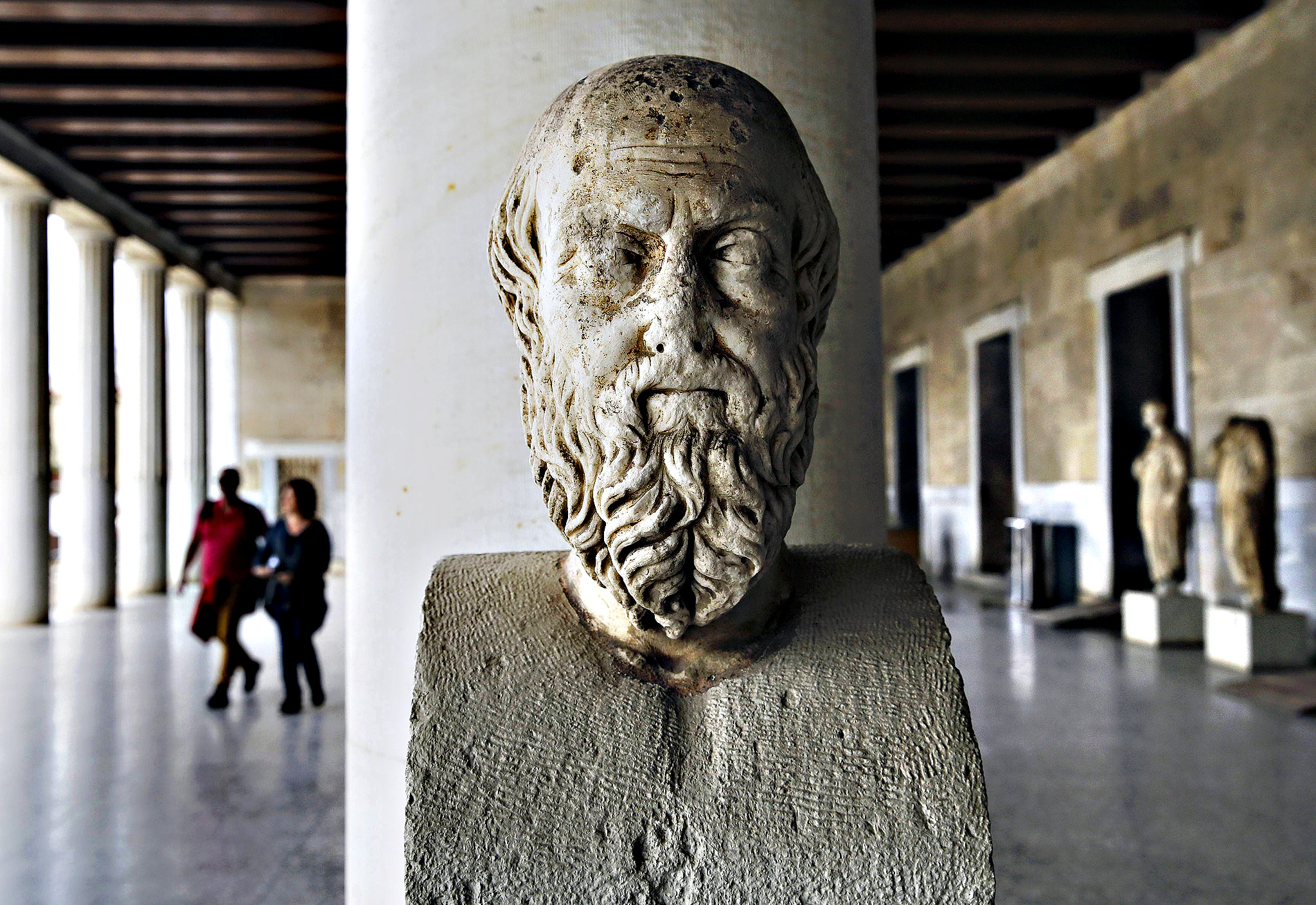
Herodotus (484 BC – c. 425 BC) was a Greek Historian as well
as known as the Father of Lies. These
two titles were commonly held hand in hand as the early recorders of history
were attempting to record an objective recounting of events while taking their
stories from first-hand, second-hand, third-hand, etc accounts instead of
recording a direct experience. Also
entwined in the pejorative label of “Father of Lies” is that Herodotus was susceptible
to subjective inclusion or exclusion of histories based on his personal
involvement with peoples. Thebans and
Corinthians who both denied him funds for his work subsequently suffered not the prettiest of
pictures when recounted in Herodotus' work.
Athenians gave him a fortune, thus perhaps securing a favorable telling
of their exploits. Regardless, Herodotus
was one of the first writers to bring together historical accounts (whether
tweaked by the tellers or himself or not) and the only one to have survived in
the form of The Histories. Therefore,
the moniker of Father of History sticks.
What is known about Herodotus's life is suspect, not unlike
any ancient figure subject to the development of accurately written
records. What is most often referred to
is an eleventh-century Byzantine lexicon, the Suda. According to this document, Herodotus was
born in Halicarnassus and that at some point was banished from his birthplace
by the tyrant Lygdamis to the island of Samos.
He returned to Halicarnassus to participate in the overthrowing of the
tyrant but was not in the favor of the citizens and therefore left for Thurii,
a colony in Southern Italy that was Athenian-led. This is where he perhaps died although there
is speculation that he may have perished in Macedonia at Pella. He wrote in the Ionian dialect of Greek which
differed from the Dorian community of Halicarnassus although the public
documents were written in Ionian. It is
also possible that Herodotus picked up the usage of Ionian while on Samos; due
to the repeated aggressions of his birthplace upon himself (first the tyrant,
then citizens) this may have inspired Herodotus to discard the Dorian
dialect. The tradition of exiling
historians did not stop with Herodotus, and in truth it may that it is merely
assumed that he was exiled twice, it was rather common for following historians
to be exiled from their homelands as well.
And for Herodotus, this does seem to ring true for it can be seen as the
condition to inspire his wide travels.
Another aspect that may play a role in allowing Herodotus to
find the wherewithal to travel and experience widely with an open mind towards
peoples and places outside of Greece was the friendliness of the city
Halicarnassus to the Carians, subject to Persia. The city also helped to develop Greek trade
with Egypt and maintained an international feel. Herodotus himself is said to have traveled to
the islands of the Archipelago, the Persian capital Susa, Babylon, Colchis,
Scythia, Thrace; he saw the shores of not only the Black Sea as far as Dnieper,
but those of Palestine as well, seeing Gaza.
This is a mere slice of the destinations that Herodotus undertook in his
search for 'human achievements' and 'to say what it said'. History did not necessarily begin as an
attempt to frame events objectively as it came to be known. The original Greek, historia was used to
describe investigation and inquiry and by traveling, seeing what he could see
and hearing what he could hear, Herodotus set out to inquire upon human
achievements. The point that Herodotus
was out to recount specifically 'human' achievement' set him apart from epic
poets who tell tales of gods and humans.
Upon visiting a place that he was out to understand, Herodotus would
take in everything he could see from monuments to customs to architecture to
climate. Herodotus would also talk to
many people and would recount the different accounts before choosing to promote
the one that he found most probable.
This is probably what garnered him the moniker of Father of Lies for
within his history exist some pretty tall tales.
What Herodotus did with what he had learned is very
well-known as The Histories, but this chunk of prose published all at once was
not what he would have been known for until later in his life. It is speculated that The Histories must have
been around 415 BC. Before that,
Herodotus's craft would have looked very much like Homer's. The culture around the Mediterranean was oral
and not written and just as Herodotus gained his knowledge from oral
storytelling, he passed on much of it in this way as well. Herodotus would travel not only to gather
information and histories, but to expel some of his gained wisdom and tales at
larger festivals that would gather large diverse crowds, or within smaller
gatherings not unlike the description of such a get together in Plato's
Symposium. When reading The Histories it
is possible to see how the different books may be broken down into smaller
chunks that were individual performance pieces.
When The Histories were collected, they were broken into
nine parts, each named after the nine Muses with Clio, the Muse of History
taking claim over the first book. The
rest of the book follows what can be seen as a loose history of four Persian
kings. The history of Cyrus takes up the
first book, Cambyses takes up Book 2 and some of three which leads into the
dynastic history of Darius whose reign fills up the books up to 6, and finally
Xerxes caps of The Histories in Books 7 and 8.
This is perhaps the most broad way to get an overview of the crafting of
The Histories although Herodotus learned, perhaps from Homer, that this method
is excellent for storing great variety and movement of many narratives. The Persian-Greek Wars provided some
time-line thematic structure (even though Herodotus would weave backwards and
forwards in time at point), but other thematic structure is to be found as well
throughout The Histories. One such theme
was Herodotus's view of the interaction of human action and its influence on historical
causation, that of retribution and vengeance and that those who wrong others
will see their payment coming to them.
Another such theme is Herodotus's commonly held Greek belief that pride
goes before the inevitable fall. This
hubris is often seen in Herodotus's histories as the expansion of empires.
Herodotus was incredibly popular in his time and following,
but along with this popularity came great derision on the part of some critics,
mostly due to the inconsistency of his stories with the truth. But even those fantastical tales, like the
one about Pakistan with its fox-sized furry ants that dig gold up from the
ground have been found to be true as more and more we still come to understand
the world. (The ants are actually
marmots who burrow in gold dust rich sand, as found by French ethnologist,
Michel Peissel.) More important than the
truth of Herodotus's stories, however, is what they accomplished. By telling stories of many different peoples
in light of Greek culture, he was able to build a sense of place in and amongst
the world for not only a Greek audience but others who could see the human
achievements available anywhere with human failings being as easily found as
well. As John Marincola remarks in his
introduction to The Histories in connection to the terrible criticism of this
Father of History:
If, however, we eliminate these preconceptions and
expectations, we may be better able to see Herodotus as a complex writer, who
viewed the past not exclusively through the narrow prism of wars and politics,
but in the variety and richness of what human beings had sought to achieve
[…] For he did nothing less than attempt
to fashion for his contemporaries (and in a different way, for those who still
read him) a portrait of themselves and of others, and of the vast world, both
physical and metaphysical, within which their actions take place.”
Week 8
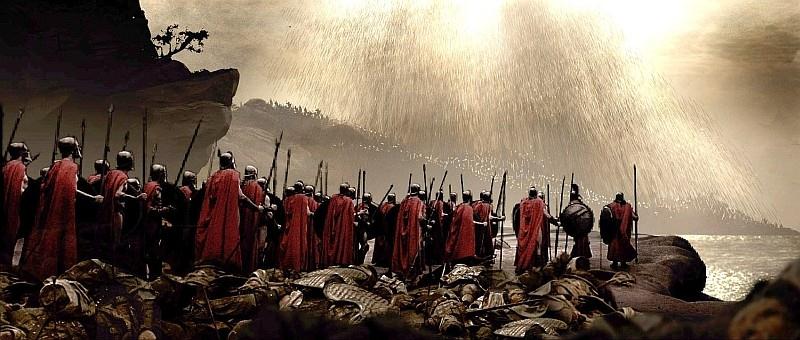
The Battle of Thermopylae
[HERODOTUS, THE HISTORY OF HERODOTUS, GEORGE RAWLINSON, TR. VOL. 4 (NEW YORK: D. APPLEMAN AND COMPANY), BK. 7]
201. King Xerxes pitched his camp in the region of Malis called Trachinia, while on their side the Greeks occupied the straits. These straits the Greeks in general call Thermopylae (the Hot Gates); but the natives, and those who dwell in the neighbourhood, call them Pylae (the Gate). Here then the two armies took their stand; the one master of all the region lying north of Trachis, the other of the country extending southward of that place to the verge of the continent.202. The Greeks who at this spot awaited the coming of Xerxes were the following: - From Sparta, three hundred men-at-arms: from Arcadia, a thousand Tegeans and Mantineans, five hundred of each people; a hundred and twenty Orchomenians, from the Arcadian Orchomenus; and a thousand from other cities: from Corinth, four hundred men: from Phlius, two hundred: and from Mycenae eighty. Such was the number from the Peloponnese. There were also present, from Boeotia, seven hundred Thespians and four hundred Thebans.
203. Besides these troops, the Locrians of Opus and the Phocians had obeyed the call of their countrymen, and sent, the former all the force they had, the latter a thousand men. For envoys had gone from the Greeks at Thermopylae among the Locrians and Phocians, to call on them for assistance, and to say - "They were themselves but the vanguard of the host, sent to precede the main body, which might every day be expected to follow them. The sea was in good keeping, watched by the Athenians, the Eginetans, and the rest of the fleet. There was no cause why they should fear; for after all the invader was not a god but a man; and there never had been, and never would be, a man who was not liable to misfortunes from the very day of his birth, and those misfortunes greater in proportion to his own greatness. The assailant therefore, being only a mortal, must needs fall from his glory." Thus urged, the Locrians and the Phocians had come with their troops to Trachis.
204. The various nations had each captains of their own under whom they served; but the one to whom all especially looked up, and who had the command of the entire force, was the Lacedaemonian, Leonidas. Now Leonidas was the son of Anaxandridas, who was the son of Leo, who was the son of Eurycratidas, who was the son of Anaxander, who was the son of Eurycrates, who was the son of Polydorus, who was the son of Alcamenes, who was the son of Telecles, who was the son of Archelaus, who was the son of Agesilaus, who was the son of Doryssus, who was the son of Labotas, who was the son of Echestratus, who was the son of Agis, who was the son of Eurythenes, who was the son of Aristodemus, who was the son of Aristomachus, who was the son of Cleodaeus, who was the son of Hyllus, who was the son of Hercules. Leonidas had come to be king of Sparta quite unexpectedly.
205. Having two elder brothers, Cleomenes and Dorieus, he had no thought of ever mounting the throne. However, when Cleomenes died without male offspring, as Dorieus was likewise deceased, having perished in Sicily, the crown fell to Leonidas, who was older than Cleombrotus, the youngest of the sons of Anaxandridas, and, moreover, was married to the daughter of Cleomenes. He had now come to Thermopylae, accompanied by the three hundred men which the law assigned him, whom he had himself chosen from among the citizens, and who were all of them fathers with sons living. On his way he had taken the troops from Thebes, whose number I have already mentioned, and who were under the command of Leontiades the son of Eurymachus. The reason why he a made a point of taking troops from Thebes, and Thebes only, was, that the Thebans were strongly suspected of being well inclined to the Medes. Leonidas therefore called on them to come with him to the war, wishing to see whether they would comply with his demand, or openly refuse, and disclaim the Greek alliance. They, however, though their wishes leant the other way, nevertheless sent the men.
206. The force with Leonidas was sent forward by the Spartans in advance of their main body, that the sight of them might encourage the allies to fight, and hinder them from going over to the Medes, as it was likely they might have done had they seen that Sparta was backward. They intended presently, when they had celebrated the Carneian festival, which was what now kept them at home, to leave a garrison in Sparta, and hasten in full force to join the army. The rest of the allies also intended to act similarly; for it happened that the Olympic festival fell exactly at this same period. None of them looked to see the contest at Thermopylae decided so speedily; wherefore they were content to send forward a mere advanced guard. Such accordingly were the intentions of the allies.
207. The Greek forces at Thermopylae, when the Persian army drew near to the entrance of the pass, were seized with fear; and a council was held to consider about a retreat. It was the wish of the Peloponnesians generally that the army should fall back upon the Peloponnese, and there guard the Isthmus. But Leonidas, who saw with what indignation the Phocians and Locrians heard of this plan, gave his voice for remaining where they were, while they sent envoys to the several cities to ask for help, since they were too few to make a stand against an army like that of the Medes.
208. While this debate was going on, Xerxes sent a mounted spy to observe the Greeks, and note how many they were, and see what they were doing. He had heard, before he came out of Thessaly, that a few men were assembled at this place, and that at their head were certain Lacedaemonians, under Leonidas, a descendant of Hercules. The horseman rode up to the camp, and looked about him, but did not see the whole army; for such as were on the further side of the wall (which had been rebuilt and was now carefully guarded) it was not possible for him to behold; but he observed those on the outside, who were encamped in front of the rampart. It chanced that at this time the Lacedaemonians held the outer guard, and were seen by the spy, some of them engaged in gymnastic exercises, others combing their long hair. At this the spy greatly marvelled, but he counted their number, and when he had taken accurate note of everything, he rode back quietly; for no one pursued after him, nor paid any heed to his visit. So he returned, and told Xerxes all that he had seen.
209. Upon this, Xerxes, who had no means of surmising the truth - namely, that the Spartans were preparing to do or die manfully - but thought it laughable that they should be engaged in such employments, sent and called to his presence Demaratus the son of Ariston, who still remained with the army. When he appeared, Xerxes told him all that he had heard, and questioned him concerning the news, since he was anxious to understand the meaning of such behaviour on the part of the Spartans. Then Demaratus said -
"I spake to thee, O king! concerning these men long since, when we had but just begun our march upon Greece; thou, however, didst only laugh at my words, when I told thee of all this, which I saw would come to pass. Earnestly do I struggle at all times to speak truth to thee, sire; and now listen to it once more. These men have come to dispute the pass with us; and it is for this that they are now making ready. 'Tis their custom, when they are about to hazard their lives, to adorn their heads with care. Be assured, however, that if thou canst subdue the men who are here and the Lacedaemonians who remain in Sparta, there is no other nation in all the world which will venture to lift a hand in their defence. Thou hast now to deal with the first kingdom and town in Greece, and with the bravest men."
Then Xerxes, to whom what Demaratus said seemed altogether to surpass belief, asked further, "how it was possible for so small an army to contend with his?"
"O king!" Demaratus answered, "let me be treated as a liar, if matters fall not out as I say."
210. But Xerxes was not persuaded any the more. Four whole days he suffered to go by, expecting that the Greeks would run away. When, however, he found on the fifth that they were not gone, thinking that their firm stand was mere impudence and recklessness, he grew wroth, and sent against them the Medes and Cissians, with orders to take them alive and bring them into his presence. Then the Medes rushed forward and charged the Greeks, but fell in vast numbers: others however took the places of the slain, and would not be beaten off, though they suffered terrible losses. In this way it became clear to all, and especially to the king, that though he had plenty of combatants, he had but very few warriors. The struggle, however, continued during the whole day.
Part IX
211. Then the Medes, having met so rough a reception, withdrew from the fight; and their place was taken by the band of Persians under Hydarnes, whom the king called his "Immortals: " they, it was thought, would soon finish the business. But when they joined battle with the Greeks, 'twas with no better success than the Median detachment - things went much as before - the two armies fighting in a narrow space, and the barbarians using shorter spears than the Greeks, and having no advantage from their numbers. The Lacedaemonians fought in a way worthy of note, and showed themselves far more skilful in fight than their adversaries, often turning their backs, and making as though they were all flying away, on which the barbarians would rush after them with much noise and shouting, when the Spartans at their approach would wheel round and face their pursuers, in this way destroying vast numbers of the enemy. Some Spartans likewise fell in these encounters, but only a very few. At last the Persians, finding that all their efforts to gain the pass availed nothing, and that, whether they attacked by divisions or in any other way, it was to no purpose, withdrew to their own quarters.
212. During these assaults, it is said that Xerxes, who was watching the battle, thrice leaped from the throne on which he sat, in terror for his army. Next day the combat was renewed, but with no better success on the part of the barbarians. The Greeks were so few that the barbarians hoped to find them disabled, by reason of their wounds, from offering any further resistance; and so they once more attacked them. But the Greeks were drawn up in detachments according to their cities, and bore the brunt of the battle in turns, - all except the Phocians, who had been stationed on the mountain to guard the pathway. So, when the Persians found no difference between that day and the preceding, they again retired to their quarters.
213. Now, as the king was in a great strait, and knew not how he should deal with the emergency, Ephialtes, the son of Eurydemus, a man of Malis, came to him and was admitted to a conference. Stirred by the hope of receiving a rich reward at the king's hands, he had come to tell him of the pathway which led across the mountain to Thermopylae; by which disclosure he brought destruction on the band of Greeks who had there withstood the barbarians. This Ephialtes afterwards, from fear of the Lacedaemonians, fled into Thessaly; and during his exile, in an assembly of the Amphictyons held at Pylae, a price was set upon his head by the Pylagorae. When some time had gone by, he returned from exile, and went to Anticyra, where he was slain by Athenades, a native of Trachis. Athenades did not slay him for his treachery, but for another reason, which I shall mention in a later part of my history: yet still the Lacedaemonians honoured him none the less. Thus then did Ephialtes perish a long time afterwards.
214. Besides this there is another story told, which I do not at all believe - to wit, that Onetas the son of Phanagoras, a native of Carystus, and Corydallus, a man of Anticyra, were the persons who spoke on this matter to the king, and took the Persians across the mountain. One may guess which story is true, from the fact that the deputies of the Greeks, the Pylagorae, who must have had the best means of ascertaining the truth, did not offer the reward for the heads of Onetas and Corydallus, but for that of Ephialtes of Trachis; and again from the flight of Ephialtes, which we know to have been on this account. Onetas, I allow, although he was not a Malian, might have been acquainted with the path, if he had lived much in that part of the country; but as Ephialtes was the person who actually led the Persians round the mountain by the pathway, I leave his name on record as that of the man who did the deed.
215. Great was the joy of Xerxes on this occasion; and as he approved highly of the enterprise which Ephialtes undertook to accomplish, he forthwith sent upon the errand Hydarnes, and the Persians under him. The troops left the camp about the time of the lighting of the lamps. The pathway along which they went was first discovered by the Malians of these parts, who soon afterwards led the Thessalians by it to attack the Phocians, at the time when the Phocians fortified the pass with a wall, and so put themselves under covert from danger. And ever since, the path has always been put to an ill use by the Malians.
216. The course which it takes is the following: - Beginning at the Asopus, where that stream flows through the cleft in the hills, it runs along the ridge of the mountain (which is called, like the pathway over it, Anopaea), and ends at the city of Alpenus - the first Locrian town as you come from Malis - by the stone called Melampygus and the seats of the Cercopians. Here it is as narrow as at any other point.
217. The Persians took this path, and, crossing the Asopus, continued their march through the whole of the night, having the mountains of Oeta on their right hand, and on their left those of Trachis. At dawn of day they found themselves close to the summit. Now the hill was guarded, as I have already said, by a thousand Phocian men-at-arms, who were placed there to defend the pathway, and at the same time to secure their own country. They had been given the guard of the mountain path, while the other Greeks defended the pass below, because they had volunteered for the service, and had pledged themselves to Leonidas to maintain the post.
218. The ascent of the Persians became known to the Phocians in the following manner: - During all the time that they were making their way up, the Greeks remained unconscious of it, inasmuch as the whole mountain was covered with groves of oak; but it happened that the air was very still, and the leaves which the Persians stirred with their feet made, as it was likely they would, a loud rustling, whereupon the Phocians jumped up and flew to seize their arms. In a moment the barbarians came in sight, and, perceiving men arming themselves, were greatly amazed; for they had fallen in with an enemy when they expected no opposition. Hydarnes, alarmed at the sight, and fearing lest the Phocians might be Lacedaemonians, inquired of Ephialtes to what nation these troops belonged. Ephialtes told him the exact truth, whereupon he arrayed his Persians for battle. The Phocians, galled by the showers of arrows to which they were exposed, and imagining themselves the special object of the Persian attack, fled hastily to the crest of the mountain, and there made ready to meet death; but while their mistake continued, the Persians, with Ephialtes and Hydarnes, not thinking it worth their while to delay on account of Phocians, passed on and descended the mountain with all possible speed.
219. The Greeks at Thermopylae received the first warning of the destruction which the dawn would bring on them from the seer Megistias, who read their fate in the victims as he was sacrificing. After this deserters came in, and brought the news that the Persians were marching round by the hills: it was still night when these men arrived. Last of all, the scouts came running down from the heights, and brought in the same accounts, when the day was just beginning to break. Then the Greeks held a council to consider what they should do, and here opinions were divided: some were strong against quitting their post, while others contended to the contrary. So when the council had broken up, part of the troops departed and went their ways homeward to their several states; part however resolved to remain, and to stand by Leonidas to the last.
220. It is said that Leonidas himself sent away the troops who departed, because he tendered their safety, but thought it unseemly that either he or his Spartans should quit the post which they had been especially sent to guard. For my own part, I incline to think that Leonidas gave the order, because he perceived the allies to be out of heart and unwilling to encounter the danger to which his own mind was made up. He therefore commanded them to retreat, but said that he himself could not draw back with honour; knowing that, if he stayed, glory awaited him, and that Sparta in that case would not lose her prosperity. For when the Spartans, at the very beginning of the war, sent to consult the oracle concerning it, the answer which they received from the Pythoness was, "that either Sparta must be overthrown by the barbarians, or one of her kings must perish." The prophecy was delivered in hexameter verse, and ran thus: -
- "O ye men who dwell in the streets of broad Lacedaemon!
- Either your glorious town shall be sacked by the children of Perseus,
- Or, in exchange, must all through the whole Laconian country
- Mourn for the loss of a king, descendant of great Heracles.
- He cannot be withstood by the courage of bulls nor of lions,
- Strive as they may; he is mighty as Jove;
- there is nought that shall stay him,
- Till he have got for his prey your king, or your glorious city."
221. To me it seems no small argument in favour of this view, that the seer also who accompanied the army, Megistias, the Acarnanian, - said to have been of the blood of Melampus, and the same who was led by the appearance of the victims to warn the Greeks of the danger which threatened them, - received orders to retire (as it is certain he did) from Leonidas, that he might escape the coming destruction. Megistias, however, though bidden to depart, refused, and stayed with the army; but he had an only son present with the expedition, whom he now sent away.
222. So the allies, when Leonidas ordered them to retire, obeyed him and forthwith departed. Only the Thespians and the Thebans remained with the Spartans; and of these the Thebans were kept back by Leonidas as hostages, very much against their will. The Thespians, on the contrary, stayed entirely of their own accord, refusing to retreat, and declaring that they would not forsake Leonidas and his followers. So they abode with the Spartans, and died with them. Their leader was Demophilus, the son of Diadromes.
223. At sunrise Xerxes made libations, after which he waited until the time when the forum is wont to fill, and then began his advance. Ephialtes had instructed him thus, as the descent of the mountain is much quicker, and the distance much shorter, than the way round the hills, and the ascent. So the barbarians under Xerxes began to draw nigh; and the Greeks under Leonidas, as they now went forth determined to die, advanced much further than on previous days, until they reached the more open portion of the pass. Hitherto they had held their station within the wall, and from this had gone forth to fight at the point where the pass was the narrowest. Now they joined battle beyond the defile, and carried slaughter among the barbarians, who fell in heaps. Behind them the captains of the squadrons, armed with whips, urged their men forward with continual blows. Many were thrust into the sea, and there perished; a still greater number were trampled to death by their own soldiers; no one heeded the dying. For the Greeks, reckless of their own safety and desperate, since they knew that, as the mountain had been crossed, their destruction was nigh at hand, exerted themselves with the most furious valour against the barbarians.
224. By this time the spears of the greater number were all shivered, and with their swords they hewed down the ranks of the Persians; and here, as they strove, Leonidas fell fighting bravely, together with many other famous Spartans, whose names I have taken care to learn on account of their great worthiness, as indeed I have those of all the three hundred. There fell too at the same time very many famous Persians: among them, two sons of Darius, Abrocomes and Hyperanthes, his children by Phratagune, the daughter of Artanes. Artanes was brother of King Darius, being a son of Hystaspes, the son of Arsames; and when he gave his daughter to the king, he made him heir likewise of all his substance; for she was his only child.
225. Thus two brothers of Xerxes here fought and fell. And now there arose a fierce struggle between the Persians and the Lacedaemonians over the body of Leonidas, in which the Greeks four times drove back the enemy, and at last by their great bravery succeeded in bearing off the body. This combat was scarcely ended when the Persians with Ephialtes approached; and the Greeks, informed that they drew nigh, made a change in the manner of their fighting. Drawing back into the narrowest part of the pass, and retreating even behind the cross wall, they posted themselves upon a hillock, where they stood all drawn up together in one close body, except only the Thebans. The hillock whereof I speak is at the entrance of the straits, where the stone lion stands which was set up in honour of Leonidas. Here they defended themselves to the last, such as still had swords using them, and the others resisting with their hands and teeth; till the barbarians, who in part had pulled down the wall and attacked them in front, in part had gone round and now encircled them upon every side, overwhelmed and buried the remnant which was left beneath showers of missile weapons.
226. Thus nobly did the whole body of Lacedaemonians and Thespians behave; but nevertheless one man is said to have distinguished himself above all the rest, to wit, Dieneces the Spartan. A speech which he made before the Greeks engaged the Medes, remains on record. One of the Trachinians told him, "Such was the number of the barbarians, that when they shot forth their arrows the sun would be darkened by their multitude." Dieneces, not at all frightened at these words, but making light of the Median numbers, answered, "Our Trachinian friend brings us excellent tidings. If the Medes darken the sun, we shall have our fight in the shade." Other sayings too of a like nature are reported to have been left on record by this same person.
227. Next to him two brothers, Lacedaemonians, are reputed to have made themselves conspicuous: they were named Alpheus and Maro, and were the sons of Orsiphantus. There was also a Thespian who gained greater glory than any of his countrymen: he was a man called Dithyrambus, the son of Harmatidas.
228. The slain were buried where they fell; and in their honour, nor less in honour of those who died before Leonidas sent the allies away, an inscription was set up, which said: -
- "Here did four thousand men from Pelops'land
- Against three hundred myriads bravely stand."
- This was in honour of all. Another was for the Spartans alone: -
- "Go, stranger, and to Lacedaemon tell
- That here, obeying her behests, we fell."
- This was for the Lacedaemonians. The seer had the following: -
- "The great Megistias' tomb you here may view,
- Whom slew the Medes, fresh from Spercheius' fords.
- Well the wise seer the coming death foreknew,
- Yet scorned he to forsake his Spartan lords."
229. Two of the three hundred, it is said, Aristodemus and Eurytus, having been attacked by a disease of the eyes, had received orders from Leonidas to quit the camp; and both lay at Alpeni in the worst stage of the malady. These two men might, had they been so minded, have agreed together to return alive to Sparta; or if they did not like to return, they might have gone both to the field and fallen with their countrymen. But at this time, when either way was open to them, unhappily they could not agree, but took contrary courses. Eurytus no sooner heard that the Persians had come round the mountain than straightway he called for his armour, and having buckled it on, bade his Helot lead him to the place where his friends were fighting. The Helot did so, and then turned and fled; but Eurytus plunged into the thick of the battle, and so perished. Aristodemus, on the other hand, was faint of heart, and remained at Alpeni. It is my belief that if Aristodemus only had been sick and returned, or if both had come back together, the Spartans would have been content and felt no anger; but when there were two men with the very same excuse, and one of them was chary of his life, while the other freely gave it, they could not but be very wroth with the former.
230. This is the account which some give of the escape of Aristodemus. Others say that he, with another, had been sent on a message from the army, and, having it in his power to return in time for the battle, purposely loitered on the road, and so survived his comrades; while his fellow-messenger came back in time, and fell in the battle.
231. When Aristodemus returned to Lacedaemon, reproach and disgrace awaited him; disgrace, inasmuch as no Spartan would give him a light to kindle his fire, or so much as address a word to him; and reproach, since all spoke of him as "the craven." However he wiped away all his shame afterwards at the battle of Plataea.
232. Another of the three hundred is likewise said to have survived the battle, a man named Pantites, whom Leonidas had sent on an embassy into Thessaly. He, they say, on his return to Sparta, found himself in such disesteem that he hanged himself.
233. The Thebans under the command of Leontiades remained with the Greeks, and fought against the barbarians, only so long as necessity compelled them. No sooner did they see victory inclining to the Persians, and the Greeks under Leonidas hurrying with all speed towards the hillock, than they moved away from their companions, and with hands upraised advanced towards the barbarians, exclaiming, as was indeed most true, - "that they for their part wished well to the Medes, and had been among the first to give earth and water to the king; force alone had brought them to Thermopylae; and so they must not be blamed for the slaughter which had befallen the king's army." These words, the truth of which was attested by the Thessalians, sufficed to obtain the Thebans the grant of their lives. However, their good fortune was not without some drawback; for several of them were slain by the barbarians on their first approach; and the rest, who were the greater number, had the royal mark branded upon their bodies by the command of Xerxes, - Leontiades, their captain, being the first to suffer. (This man's son, Eurymachus, was afterwards slain by the Plataeans, when he came with a band of 400 Thebans, and seized their city.)
234. Thus fought the Greeks at Thermopylae.
Friday, October 2, 2015
Week 7

A Greek philosopher of the late 6th century BC, Heraclitus criticizes his predecessors and contemporaries for their failure to see the unity in experience. He claims to announce an everlasting Word (Logos) according to which all things are one, in some sense. Opposites are necessary for life, but they are unified in a system of balanced exchanges. The world itself consists of a law-like interchange of elements, symbolized by fire. Thus the world is not to be identified with any particular substance, but rather with an ongoing process governed by a law of change. The underlying law of nature also manifests itself as a moral law for human beings.
1. LIFE AND TIMES
Heraclitus lived in Ephesus, an important city on the Ionian coast of Asia Minor, not far from Miletus, the birthplace of philosophy. We know nothing about his life other than what can be gleaned from his own statements, for all ancient biographies of him consist of nothing more than inferences or imaginary constructions based on his sayings. Although Plato thought he wrote after Parmenides, it is more likely he wrote before Parmenides. For he criticizes by name important thinkers and writers with whom he disagrees, and he does not mention Parmenides. On the other hand, Parmenides in his poem arguably echoes the words of Heraclitus. Heraclitus criticizes the mythographers Homer and Hesiod, as well as the philosophers Pythagoras and Xenophanes and the historian Hecataeus. All of these figures flourished in the 6th century BC or earlier, suggesting a date for Heraclitus in the late 6th century. Although he does not speak in detail of his political views in the extant fragments, Heraclitus seems to reflect an aristocratic disdain for the masses and favor the rule of a few wise men, for instance when he recommends that his fellow-citizens hang themselves because they have banished their most prominent leader
2. THEORY OF KNOWLEDGE
Heraclitus sees the great majority of human beings as lacking understanding:
Of this Word's being forever do men prove to be uncomprehending, both before they hear and once they have heard it. For although all things happen according to this Word they are like the unexperienced experiencing words and deeds such as I explain when I distinguish each thing according to its nature and declare how it is. Other men are unaware of what they do when they are awake just as they are forgetful of what they do when they are asleep.
Most people sleep-walk through life, not understanding what is going on about them. Yet experience of words and deeds can enlighten those who are receptive to their meaning. (The opening sentence is ambiguous: does the 'forever' go with the preceding or the following words? Heraclitus prefigures the semantic complexity of his message.)
On the one hand, Heraclitus commends sense experience: "The things of which there is sight, hearing, experience, I prefer". On the other hand, "Poor witnesses for men are their eyes and ears if they have barbarian souls". A barbarian is one who does not speak the Greek language. Thus while sense experience seems necessary for understanding, if we do not know the right language, we cannot interpret the information the senses provide. Heraclitus does not give a detailed and systematic account of the respective roles of experience and reason in knowledge. But we can learn something from his manner of expression.
Describing the practice of religious prophets, Heraclitus says, "The Lord whose oracle is at Delphi neither reveals nor conceals, but gives a sign". Similarly, Heraclitus does not reveal or conceal, but produces complex expressions that have encoded in them multiple messages for those who can interpret them. He uses puns, paradoxes, antitheses, parallels, and various rhetorical and literary devices to construct expressions that have meanings beyond the obvious. This practice, together with his emphasis on the Word (Logos) as an ordering principle of the world, suggests that he sees his own expressions as imitations of the world with its structural and semantic complexity. To read Heraclitus the reader must solve verbal puzzles, and to learn to solve these puzzles is to learn to read the signs of the world. Heraclitus stresses the inductive rather than the deductive method of grasping the world, a world that is rationally structured, if we can but discern its shape.
For those who can discern it, the Word has an overriding message to impart: "Listening not to me but to the Word it is wise to agree that all things are one". It is perhaps Heraclitus's chief project to explain in what sense all things are one.
3. THE DOCTRINE OF FLUX AND THE UNITY OF OPPOSITES
According to both Plato and Aristotle, Heraclitus held that:
(1) everything is constantly changing and
(2) opposite things are identical
Plato indicates the source of the flux doctrine:
"Heraclitus, I believe, says that all things go and nothing stays, and comparing existence to the flow of a river, he says you cannot step twice into the same river" .
*********************************************************************************
· Blog, please write a 75-250 word post discussing Heraclitus’s famous quote: "No man ever steps in the same river twice." Your post should speculate on what you believe Heraclitus meant, the implications of this idea, and your opinion of the concept. Be prepared to share your thoughts in class.
Saturday, September 12, 2015
Monday, August 24, 2015
Week 2 Homework

Read the following excerpt from the Code of Hammurabi, make a guess as to the intent of the law and its subsequent punishment, written in one paragraph. In another paragraph, discuss what this law might have to say about Babylonian civilization. If you are unable to post your paragraphs on the blog, please be sure to print them, and bring them to class.
“If a female tavern-keeper does not accept corn according to gross weight in payment of a drink, but takes money, and the price of the drink is less than that of the corn, she shall be convicted and thrown into the water.”
Friday, May 1, 2015
The Transformation of Rome
The blog post has been excused, students electing to do it will receive extra credit.
Saturday, April 18, 2015
Marcus Aurelius
Online: Select and read one book (out of twelve) from Marcus Aurelius’ “Meditations.”
Prepare: Write an informal essay, 75-250 words, that reflects on your overall impression of the section of the “Meditations” that you read. Your essay should also include one saying or quote from the text that you examine in more detail. Your essay should conclude by comparing and contrasting Marcus Aurelius’ thoughts with Christianity.
Please post this essay on the blog.
Thursday, April 16, 2015
Hadrian's Wall
Vindolanda Letters Project: After watching the previous documentary. Please have a look at one of the more complete documents from this list:
Once you have found a fairly complete document, read through the English translation. Think about the letter, place it into context, and imagine who wrote it and why. Then, add further context by filling out the remainder of the letter fragment in authentic style (i.e. flesh out the words into a complete letter). Once you have done that, then imagine who received the letter and write a response to it from an imaginary correspondent (use the original letter as evidence when you write your response).
Step-by-Step:
1. Go through the lists of fragments on the website above.
2. Choose one of the fragments from the site, it should be long enough to get a sense of its intent.
3. Think about the intention of the fragment.
4. Flesh out the fragment into a complete letter
5. Write another letter responding to your fleshed out version of the fragment.
Documents: http://vindolanda.csad.ox.ac.uk/
Particularly good example
Trajan: http://www.roman-empire.net/highpoint/trajan.html
Hadrian: http://spartacus-educational.com/ROMhadrian.htm
Sunday, April 5, 2015
Quiz Update
There will be a quiz this week, it will cover the readings and the blog, it is open notes. Happy Easter!
Tuesday, March 24, 2015
Josephus 'Antiquities of the Jews'
2. But Pilate undertook to bring a current of water to Jerusalem, and did it with the sacred money, and derived the origin of the stream from the distance of two hundred furlongs. However, the Jews (8) were not pleased with what had been done about this water; and many ten thousands of the people got together, and made a clamor against him, and insisted that he should leave off that design. Some of them also used reproaches, and abused the man, as crowds of such people usually do. So he habited a great number of his soldiers in their habit, who carried daggers under their garments, and sent them to a place where they might surround them. So he bid the Jews himself go away; but they boldly casting reproaches upon him, he gave the soldiers that signal which had been beforehand agreed on; who laid upon them much greater blows than Pilate had commanded them, and equally punished those that were tumultuous, and those that were not; nor did they spare them in the least: and since the people were unarmed, and were caught by men prepared for what they were about, there were a great number of them slain by this means, and others of them ran away wounded. And thus an end was put to this sedition.
3. Now there was about this time Jesus, a wise man, he was a doer of starting works, a teacher of such men as receive the truth with pleasure. He drew over to him both many of the Jews and many of the Gentiles. And when Pilate, at the suggestion of the principal men amongst us, had condemned him to the cross, those that loved him at the first forsook him; but he appeared to some of them; the tribe of Christians, so named after him, are not extinct at this day.
4. About the same time also another sad calamity put the Jews into disorder, and certain shameful practices happened about the temple of Isis that was at Rome. I will now first take notice of the wicked attempt about the temple of Isis, and will then give an account of the Jewish affairs. There was at Rome a woman whose name was Paulina; one who, on account of the dignity of her ancestors, and by the regular conduct of a virtuous life, had a great reputation: she was also very rich; and although she was of a beautiful countenance, and in that flower of her age wherein women are the most gay, yet did she lead a life of great modesty. She was married to Saturninus, one that was every way answerable to her in an excellent character. Decius Mundus fell in love with this woman, who was a man very high in the equestrian order; and as she was of too great dignity to be caught by presents, and had already rejected them, though they had been sent in great abundance, he was still more inflamed with love to her, insomuch that he promised to give her two hundred thousand Attic drachmae; and when this would not prevail upon her, and he was not able to bear this misfortune in his amours, he thought it the best way to famish himself to death for want of food, on account of Paulina's sad refusal; and he determined with himself to die after such a manner, and he went on with his purpose accordingly. Now Mundus had a freed-woman, who had been made free by his father, whose name was Ide, one skillful in all sorts of mischief. This woman was very much grieved at the young man's resolution to kill himself, (for he did not conceal his intentions to destroy himself from others,) and came to him, and encouraged him by her discourse, and made him to hope, by some promises she gave him, that he might obtain Paulina's love; and when he joyfully hearkened to her entreaty, she said she wanted no more than fifty thousand drachmae for the entrapping of the woman. So when she had encouraged the young man, and gotten as much money as she required, she did not take the same methods as had been taken before, because she perceived that the woman was by no means to be tempted by money; but as she knew that she was very much given to the worship of the goddess Isis, she devised the following stratagem: She went to some of Isis's priests, and upon the strongest assurances of concealment, she persuaded them by words, but chiefly by the offer of money, of twenty-five thousand drachmae in hand, and as much more when the thing had taken effect; and told them the passion of the young man, and persuaded them to use all means possible to beguile the woman. So they were drawn in to promise so to do, by that large sum of gold they were to have. Accordingly, the oldest of them went immediately to Paulina; and upon his admittance, he desired to speak with her by herself. When that was granted him, he told her that he was sent by the god Anubis, who was fallen in love with her, and enjoined her to come to him. Upon this she took the message very kindly, and valued herself greatly upon this condescension of Anubis, and told her husband that she had a message sent her, and was to sup with Anubis; so he agreed to her acceptance of the offer, as fully satisfied. Accordingly, she went to the temple, and after she had supped there, and it was the hour to go to sleep, the priest shut the doors of the temple, when, in the holy part of it, the lights were also put out. Then did Mundus pretend to be the god himself; and when he was gone away, which was before those priests who knew nothing of this stratagem were stirring, Paulina came early to her husband, and told him how the god Anubis had appeared to her. Among her friends, also, she declared how great a value she put upon this favor, who partly disbelieved the thing, when they reflected on its nature, and partly were amazed at it, as having no pretense for not believing it, when they considered the modesty and the dignity of the person. But now, on the third day after what had been done, Mundus met Paulina, and said, "Nay, Paulina, thou hast saved me two hundred thousand drachmae. As for the reproaches thou hast laid upon Mundus, I value not the business of names; but I rejoice for it was I who took to myself the name of Anubis." When he had said this, he went his way. But now she began to come to the sense of what she had done, and rent her garments, and told her husband of the horrid nature of this wicked contrivance, and prayed him not to neglect to assist her in this case. So he discovered the fact to the emperor; whereupon Tiberius inquired into the matter thoroughly by examining the priests about it, and ordered them to be crucified, as well as Ide, who was the occasion of their perdition, and who had contrived the whole matter, which was so injurious to the woman. He also demolished the temple of Isis, and gave order that her statue should be thrown into the river Tiber; while he only banished Mundus, but did no more to him, because he supposed that what crime he had committed was done out of the passion of love. And these were the circumstances which concerned the temple of Isis, and the injuries occasioned by her priests. I now return to the relation of what happened about this time to the Jews at Rome, as I formerly told you I would.
5. There was a man who was a Jew, but had been driven away from his own country by an accusation laid against him for transgressing their laws, and by the fear he was under of punishment for the same; but in all respects a wicked man. He, then living at Rome, professed to instruct men in the wisdom of the laws of Moses. He procured also three other men, entirely of the same character with himself, to be his partners. These men persuaded Fulvia, a woman of great dignity, and one that had embraced the Jewish religion, to send purple and gold to the temple at Jerusalem; and when they had gotten them, they employed them for their own uses, and spent the money themselves, on which account it was that they at first required it of her. Whereupon Tiberius, who had been informed of the thing by Saturninus, the husband of Fulvia, who desired inquiry might be made about it, ordered all the Jews to be banished out of Rome; at which time the consuls listed four thousand men out of them, and sent them to the island Sardinia; but punished a greater number of them, who were unwilling to become soldiers, on account of keeping the laws of their forefathers. Thus were these Jews banished out of the city by the wickedness of four men.
Monday, March 23, 2015
Roman Feast
Hi everyone! Just a reminder that we will be having our Roman feast this week. Extra credit will be offered for any student who prepares and brings a Roman dish to share, and everyone is encouraged to bring something, if possible...
Additionally, if you would like to receive further extra credit, you may bring a Roman story, poem, or epigram to share.
Extra credit is also offered for Roman hair styles (for ladies) and/or Roman clothing.
Additionally, if you would like to receive further extra credit, you may bring a Roman story, poem, or epigram to share.
Extra credit is also offered for Roman hair styles (for ladies) and/or Roman clothing.
Tuesday, March 3, 2015
Subscribe to:
Posts (Atom)